Blog writing steps for small business success

TL;DR:
Effective blog writing is a vital skill for small businesses to enhance digital marketing efforts and attract more customers.
Preparing beforehand with tools, clear goals, and a customer-focused mindset ensures structured and valuable content creation.
You’ve got a brilliant business, a website that’s (mostly) working, and the vague sense that you should probably be blogging. But every time you sit down to write, your brain does that thing where it just… goes blank. Sound familiar? You’re not alone. Tons of small business owners know that blog writing matters for digital marketing, but the “how” feels as murky as a Tim Hortons double-double in a power outage. Here’s the good news: effective blog writing isn’t some dark art reserved for English majors. It’s a skill, it’s a process, and this guide is going to walk you through it step by step.
Table of Contents
Key Takeaways
Point | Details |
Start with a purpose | Define your audience and goals before you begin writing to maximize your blog’s impact. |
Follow a clear process | A step-by-step approach from planning to editing leads to consistent, effective blog posts. |
Optimise for results | Promote and refine every post for SEO and audience engagement to get lasting returns. |
Avoid common mistakes | Watch for errors like neglecting structure or skipping SEO to ensure your efforts pay off. |
Quality over quantity | Publishing fewer, higher-value posts can drive more business results than frequent low-quality content. |
What you need to start: Tools, mindset, and goals
Now that you understand what’s at stake, here’s what you’ll need to succeed before you even write your first word.
Let’s be honest. The biggest obstacle most entrepreneurs face isn’t a lack of ideas. It’s a lack of structure. You sit down, you stare at the cursor, and 45 minutes later you’re deep in a YouTube rabbit hole watching videos of golden retrievers learning to skateboard. We’ve all been there. 🐕
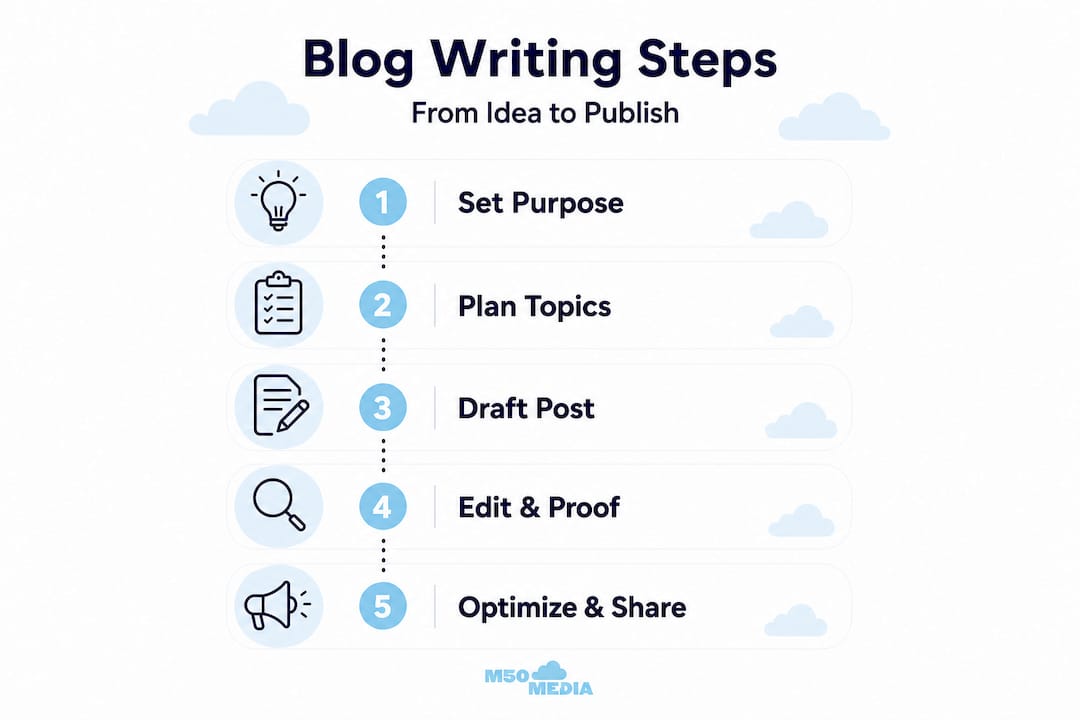
The good news? Strategic planning and clear objectives lead to higher engagement and blog success. That means before you write a single word, you need a plan. Think of it like building a house. You wouldn’t just start hammering nails without a blueprint, right? (Unless you’re renovating, in which case, good luck and Godspeed.)
Here’s a quick look at the core tools you’ll want in your blogging toolkit:
Tool | What it does | Why it matters |
Content calendar | Schedules your post topics and publish dates | Keeps you consistent and accountable |
Headline analyser | Scores the strength of your blog titles | Weak headlines kill great content |
Keyword planner | Finds the words your audience is searching | Connects you with people already looking |
Readability checker | Measures how easy your posts are to read | Makes sure real humans actually enjoy it |
Beyond tools, your mindset is everything. Commit to delivering genuine value to your reader, not just filling a page. Think about your customers’ real problems and write with the goal of actually solving them. That’s the mindset shift that separates blogs that build businesses from blogs that just collect digital dust.
Here are the essentials to check off before you start:
Know who you’re writing for (be specific, not “everyone”)
Define a clear goal for each post: traffic, leads, or authority
Choose one focused topic per post (not three)
Have a content marketing tips resource bookmarked for when you get stuck
Keep a running list of customer questions you hear all the time (these are gold)
Pro Tip: Use your content calendar to plan at least four weeks ahead. Scrambling for a topic at midnight on a Tuesday is not a vibe.
And if you’re wondering how to write blog content that actually sounds like a real person wrote it (and not a robot), check out these authentic content tips for some genuinely useful guidance on keeping things human.
Step-by-step: Writing an effective blog post
With your toolkit and mindset ready, let’s move on to the practical steps for writing compelling blog posts.
A structured blog workflow leads to more efficient content creation and stronger results. Think of this process less like writing an essay for school and more like having a great conversation with a customer. You’ve got something useful to say. Let’s get it out in a way that people will actually read.
Write your headline first. Your headline is the first impression, the handshake, the “hey, how’s it going?” of your blog post. Use a headline analyser to test it. Aim for something specific and benefit-driven, not vague. “Tips for your business” is weak. “Five blog writing steps that attract your first 100 readers” is a winner.
Build a simple outline. Three to five main points are plenty. Your outline is your GPS. Without it, you’ll meander, ramble, and end up somewhere very far from where you intended. (Kind of like that road trip you took in 2019 without Google Maps.)
Write the draft without editing. This is the part where you just get the words out. Don’t stop to fix spelling, rearrange paragraphs, or second-guess yourself. Draft first, polish later. Think of your first draft as scaffolding, it doesn’t have to be pretty, it just has to hold things up.
Focus on your customer’s pain points. Every paragraph should pass the “so what?” test. Why does your reader care about this? What problem does it solve for them? If you can’t answer that, cut the paragraph.
Edit for clarity, SEO, and flow. Now you put on your editor’s hat. Read it out loud. If you stumble on a sentence, your reader will too. Check that your primary keyword appears naturally in the title, the first paragraph, and a few times throughout. For practical copywriting tips that’ll sharpen your editing instincts, give that a read between drafts.
Check for voice and authenticity. Does it sound like you? Does it sound like a real human wrote it? If it reads like a press release from 2003, rewrite it in plain, conversational English.
Here’s a quick comparison of blog posts that work versus ones that don’t:
What works | What doesn’t |
Specific, benefit-driven headline | Vague or generic title |
Clear structure with headings | One giant wall of text |
Addresses a real customer question | Written for search engines only |
Conversational, friendly tone | Stiff, formal corporate language |
Ends with a clear call-to-action | Fades out with no direction |
For even more real-world inspiration, browse the M50 blog for examples of posts that hit the mark for small business audiences.
Pro Tip: Write your introduction last. Once you know what the whole post says, it’s much easier to hook people at the start.
Optimising your blog post for reach and results
After mastering the writing process, it’s time to ensure your hard work connects with your audience and delivers measurable results.

Here’s a truth that stings a little: you can write the most beautiful, insightful blog post in the history of small business content, and if nobody sees it, it might as well be a note you wrote to yourself on a Post-it. Optimising blog content boosts search rankings and organic traffic for small businesses. So let’s make sure your hard work actually gets found.
Run through this quick SEO and promotion checklist before you hit publish:
Your primary keyword appears in the title, the first 100 words, and at least two subheadings
Your meta description (the blurb that shows up in Google search) is 150 to 160 characters and includes your keyword
You’ve included at least one internal link to another page on your site
Your post has at least one high-quality image with alt text that describes it
There’s a clear call-to-action at the end (what do you want the reader to do next?)
You’ve broken up the text with headings, short paragraphs, and bullet points for readability
Once you publish, promotion is where things really get interesting. Share the post on the social platforms where your customers actually hang out. Repurpose a key takeaway as a social media graphic. Send it to your email list. Seriously, don’t sleep on blog promotion ideas that can multiply the reach of every post you write.
Statistic callout: Businesses that blog consistently generate 67% more leads per month than those that don’t. That’s not a small number. That’s the difference between a quiet inbox and one that’s actually working for you.
And when it comes to making your content both authentic and SEO-friendly (because yes, you can have both), these tips on enhancing blog authenticity are genuinely worth your time.
Pro Tip: Repurpose every blog post into at least three social media posts. You wrote the content. Make it work harder for you across multiple channels.
Troubleshooting: Common blog writing mistakes to avoid
Even with strong preparation and execution, it’s easy to stumble into traps that undermine your results. Here’s how to stay on track.
Nobody writes a perfect blog post every time. Not even the pros. But avoiding common mistakes helps small businesses increase their blog’s effectiveness and ROI. So let’s talk about the pitfalls that trip up the most enthusiastic bloggers.
Here are the most common ones to watch for:
Writing for yourself instead of your reader. Your opinion matters, but your customer’s problem matters more. Always ask: “What does my reader need from this post?”
No clear structure or purpose. If your post doesn’t have a point, readers will leave. Fast. Structure your posts with a clear beginning, middle, and end.
Ignoring SEO basics. You don’t need to be an SEO wizard. But skipping keywords, meta descriptions, and image alt text is leaving free traffic on the table.
Skipping visuals. A post with zero images is about as inviting as a menu with no pictures. Include at least one relevant image per post.
Posting randomly with no schedule. Publishing once in January and then going dark until April is not a content strategy. Consistency builds trust.
Writing headlines that nobody would click. Your headline is doing the heavy lifting. If it’s boring, people won’t even give the content a chance.
“The best blog post in the world won’t help your business if it’s poorly structured, never promoted, and written for no one in particular. Know your reader. Know your goal. Then write.” — M50 Media
For a deeper look at content creation best practices that keep your posts both readable and search-friendly, that’s a fantastic resource to bookmark right now.
And if you want a broader set of proven content marketing strategies to pair with your blogging efforts, we’ve got you covered there too.
Why effective blog writing is more about value than volume
Here’s the perspective that most blogging guides won’t give you, probably because it’s a little counterintuitive and messes with the “post every day!” narrative you see everywhere.
After years of working in digital marketing with small businesses, the pattern is pretty clear: the businesses that get real, measurable results from blogging are almost never the ones posting the most. They’re the ones posting the best.
Think about the blogs you actually read. The ones you bookmark and come back to. Are they churning out three posts a day, or are they publishing something genuinely useful once or twice a week? Exactly.
Chasing volume for the sake of volume is like filling your restaurant with tables but forgetting to hire a chef. The room looks busy, but nobody’s getting fed. Your readers can tell the difference between a post written to help them and a post written to hit a quota. And Google, increasingly, can too.
Content marketing drives more leads when it’s strategic and customer-focused. That means fewer, better posts will outperform more, mediocre ones almost every single time.
The other big mistake? Chasing trends instead of answering real customer questions. Trends fade. Your customer’s question about “how to choose the right service provider” or “what makes your business different” is evergreen. Write the answers to those questions really well, and those posts will keep pulling in traffic for years.
Consistency still matters. A lot, actually. But consistency doesn’t mean daily. It means reliably showing up with something worth reading. Once a week? Great. Twice a month but always high-quality? Also great. Random bursts of ten posts followed by three months of silence? Not great.
Build the habit of asking yourself before every post: would I actually find this helpful if I stumbled across it? If the answer is no, keep writing until it is.
Take your business blog to the next level
If you’re ready to put effective blog writing into action, the right expert guidance can make all the difference. 🚀
You’ve got the steps, the tools, and the mindset. But sometimes what really accelerates results is having someone in your corner who’s done this before. That’s exactly what M50 Media is here for.

Whether you’re looking for one-on-one business coaching to sharpen your entire digital marketing strategy, or you just need a quick gut-check from someone who knows what works, we’ve got options that fit where you’re at. Start with a no-pressure free marketing call and let’s talk about what your blog could actually be doing for your business. Because you’ve put in the work to learn this stuff. Now let’s make it count.
Frequently asked questions
How long should a blog post be for SEO and engagement?
Aim for posts of 1,000 to 2,000 words, as these tend to rank better in search results while giving readers enough substance to genuinely benefit from the content.
How often should I post on my business blog?
Consistency matters more than frequency; posting once a week or bi-weekly works well for most small businesses as long as the quality stays high.
What is the most important part of a blog post?
A strong headline and clear opening hook set the stage for engagement, because if readers don’t make it past the first few lines, nothing else in the post gets a chance.
How do I come up with blog topics for my business?
Focus on your customers’ biggest questions, common pain points, and the keywords relevant to your services, because strategic planning around real audience needs always beats guessing.
Can blog writing really help me get more customers?
Absolutely yes. Strategic blog content builds trust, attracts organic traffic, and generates qualified leads for small businesses over time.
Recommended
Comments