Why building an email list drives real growth for small businesses

TL;DR:
Email marketing provides more control and stability than social media platforms.
Building a targeted, engaged email list supports business growth at all stages.
Consistent, personalized email communication, combined with strategic segmentation, drives better results.
Think social media is your best bet for reaching customers? Here’s a plot twist: email marketing ROI consistently outperforms social media, and by a significant margin. While everyone’s busy chasing Instagram followers and TikTok trends (no judgement, it’s fun over there), smart business owners are quietly building something far more valuable: an email list they actually own. In this article, we’re breaking down exactly why email lists matter, how they fuel growth at every stage of your business, and the practical steps you can take today to start building yours. Buckle up. 🚀
Table of Contents
Key Takeaways
Point | Details |
Direct audience control | Building an email list puts your business in control of your customer relationships, without reliance on third-party platforms. |
Scalable relationship growth | Email lists allow you to nurture leads and customers with personalized, automated messages at every stage of your business. |
Higher return on investment | Email marketing consistently delivers higher ROI and engagement compared to most social media campaigns. |
Quality over quantity | A smaller, active list will always outperform a large unfocused list in driving real sales and loyalty. |
Avoid common pitfalls | Focusing on value and proper list maintenance keeps your campaigns out of the spam folder and in front of your ideal audience. |
The unique value of email lists versus other channels
Let’s get one thing straight right away. Your Instagram followers? Not really yours. Your Facebook fans? Borrowed. Your TikTok audience? One algorithm update away from disappearing into the void. Your email list, on the other hand, is yours and yours alone. No platform can take it from you, throttle your reach, or decide you’re not worth showing to your own audience today.
That’s the core magic of email marketing advantages: you control the line of communication. Full stop.
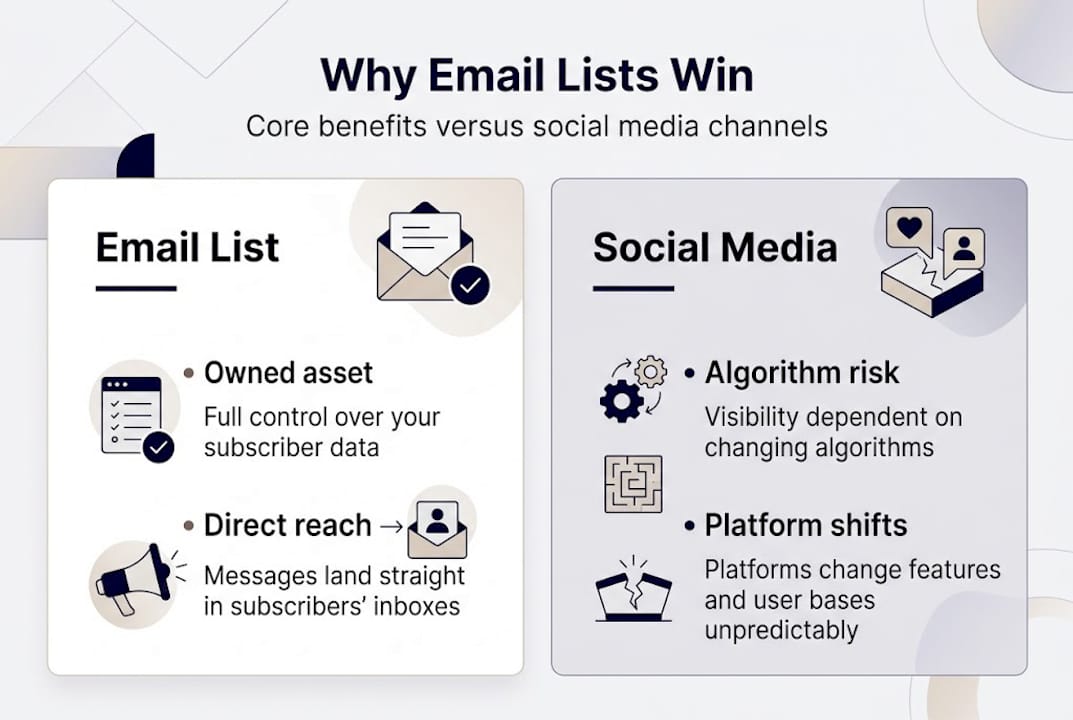
Let’s look at how email stacks up against other channels:
Channel | Average open/engagement rate | Ownership | Algorithm risk |
Email marketing | 20 to 40% open rate | You own it | None |
Instagram organic | 1 to 3% engagement rate | Platform owns it | High |
Facebook organic | Under 2% reach | Platform owns it | Very high |
Paid ads | Variable, stops when budget stops | Platform controls it | Medium |
Not exactly a flattering picture for social media, is it? Email wins on nearly every front.
Here’s what makes email lists so powerful for small business owners specifically:
Direct access: Your message lands in someone’s inbox, not buried between cat memes and sponsored posts.
Measurable results: Open rates, click-through rates, conversions. You can track everything.
Stable reach: No sudden drops because an algorithm decided to shake things up.
Cost-effective: Compared to paid ads, email is incredibly affordable to maintain.
Scalable: One email can reach 10 people or 10,000 with the same effort.
And from entrepreneur perspectives on this very topic, business owners repeatedly echo the same sentiment: losing a social platform or seeing your organic reach tank hurts, but losing your email list? That’s a catastrophe. Protect it like it’s your most valuable business asset, because it is.
The stability factor alone makes email worth the investment. Platforms come and go (remember when everyone was going to be on Clubhouse forever?). Your email list quietly keeps working.
How building an email list fuels growth at every business stage
Whether you’re a brand-new solopreneur or a small business with a growing team, email lists support growth in ways that scale beautifully with you. It’s one of those rare tools that works just as hard at the beginning as it does when you’re running at full speed.
Here’s a breakdown of how email lists support results at different stages:
Business stage | Email list role | Key benefit |
Just starting out | Capture early interested leads | Build warm audience from day one |
Growing phase | Nurture leads with automated sequences | Convert subscribers into paying customers |
Scaling up | Segment and personalise at volume | Drive repeat purchases and referrals |
So how do you actually get people from “stranger” to “loyal customer” using email? Here’s the basic roadmap:
Create a compelling lead magnet. Think free guide, discount code, mini-course, or checklist. Something genuinely useful.
Set up a sign-up form on your website and link it from your social profiles.
Send a welcome email immediately. First impressions matter enormously here.
Run an automated nurture sequence. A series of 3 to 5 emails that warm up your new subscriber and introduce your offer.
Consistently send value-packed emails. Think tips, stories, promotions, and real talk.
Pro Tip: Don’t make your lead magnet complicated. A one-page checklist that solves a specific problem your audience faces will outperform a 50-page e-book every single time. People want quick wins.
For coaches and high-ticket service providers, this is especially worth paying attention to. As noted by scaling your coaching business resources, coaches benefit enormously from email lists because they allow you to nurture dozens of potential clients simultaneously, without spending all day sending individual follow-up messages. And for product-based businesses, it’s the difference between hoping someone stumbles back onto your website and actively boosting online sales with a well-timed promotion.
Email is not just a communication tool. It’s a growth engine.
Key strategies for building and segmenting your email list
Growing a list is one thing. Growing a list that actually performs? That’s where strategy comes in. Let’s talk about how to attract the right subscribers and set your list up to deliver real results.
First, your sign-up incentives. Here’s what works well:
Free resources: Guides, templates, checklists, mini-courses, or video trainings.
Discount codes: Especially effective for e-commerce businesses.
Exclusive access: Early bird deals, members-only content, or behind-the-scenes info.
Webinars or live events: Great for service-based businesses to showcase expertise.
Quizzes with personalised results: People love learning about themselves (and yes, they’ll give you their email for it).
Once you’ve got people signing up, segmentation is your next superpower. Segmentation means dividing your list into groups based on shared characteristics, like what they bought, where they signed up, their industry, or their behaviour. Why bother? Because a pet groomer in Calgary does not want the same email as a tech founder in Toronto. Relevance drives results.
Segmentation and automation can dramatically increase email marketing performance. Here’s a simple process to get started:
Tag subscribers based on where they signed up or what lead magnet they downloaded.
Create separate sequences for different customer types or interests.
Use behavioural triggers: Did they click a link? Open three emails in a row? That’s a warm lead. Follow up accordingly.
Review your segments every quarter and update them based on subscriber activity.
Pro Tip: Tools like Klaviyo for segmentation make this process much more manageable, even if you’re a one-person show. Automation handles the heavy lifting so you can focus on running your business.
The goal is to send the right message to the right person at the right time. That’s not magic. That’s a well-segmented email list doing its job.
Common pitfalls (and how to avoid them) in email list building
Alright, let’s talk about the things that can quietly sabotage your email marketing efforts. Because knowing what to do is great, but avoiding the landmines is what keeps your list healthy and your reputation intact.
Here are the biggest mistakes small business owners make:
Buying an email list. Please, please don’t do this. Purchased lists are full of people who never asked to hear from you. Your open rates will tank, your spam complaints will soar, and your deliverability will suffer for months. It’s the marketing equivalent of crashing a party you were not invited to.
Sending generic content. If your emails could apply to literally anyone on the planet, they’ll resonate with no one. Personalise. Speak to their specific problems.
Over-emailing or ghosting. Sending five emails a week feels like spam. Sending one email every three months means your audience has forgotten you exist. Find your rhythm and stick to it.
Ignoring list hygiene. Inactive subscribers drag down your engagement rates. Clean your list every six months. Remove people who haven’t opened an email in a year. It feels counterintuitive, but a smaller engaged list beats a bloated inactive one every time.
“Quality over quantity is not just a nice saying in email marketing. It’s the actual strategy. One engaged subscriber who opens, clicks, and buys is worth a hundred uninterested names on a list.”
As marketing strategy guides consistently point out, quality trumps quantity when it comes to email list building. Avoid buying lists or sending generic content that treats your audience like a faceless crowd.

Pro Tip: Set up a simple re-engagement campaign before you clean your list. Send a “We miss you” email with a compelling reason to stay subscribed. Some of those dormant subscribers will come back. The rest? Let them go gracefully.
Your email list is a relationship. Treat it like one.
What most guides don’t tell you about email list building
Here’s the honest truth that gets left out of most shiny “grow your email list fast” articles: email is not a set-it-and-forget-it system. It’s a living, breathing part of your business that needs consistent attention and genuine effort.
Yes, automation is a game-changer. Yes, segmentation improves results. But no amount of clever tech replaces the simple act of actually caring about the people on your list. The businesses that win with email are the ones that write like a human, show up consistently, and deliver real value every single time they hit send.
For coaches and high-ticket service providers especially, a hybrid networking and email strategy works best. Email scales your nurturing, but real human connection closes the deal. Don’t abandon networking in favour of pure automation.
And one more thing: don’t ignore channels that genuinely fit your audience. Email is your anchor, your owned asset, your most reliable tool. But it works even better when paired with a social presence or content strategy that feeds new people into your list regularly. Think of email as the home base and everything else as the roads that lead people there. The email marketing engagement you build over time is what turns curious visitors into lifelong customers.
Get expert help to grow your email list faster
Ready to stop guessing and start growing? Building an email list strategically takes time, but it doesn’t have to feel overwhelming.
Karl Lundgren and the M50 Media team specialise in helping small business owners like you cut through the noise and build email marketing systems that actually work. Whether you’re starting from zero or trying to fix a list that’s gone stale, email list coaching can help you skip the trial-and-error phase and get to results faster. Not sure where to begin? Book a marketing SOS call and let’s figure out your best next step together. Your future subscribers are waiting. 📬
Frequently asked questions
What is the main advantage of building an email list over relying on social media?
Email lists are owned assets, meaning you control the connection with your audience, while social media algorithms and platform changes can limit or eliminate your reach at any time. The higher control and stability of email simply cannot be matched by rented platforms.
How can small businesses get people to join their email list?
Offering valuable lead magnets like discounts, free guides, or helpful templates is the most effective way to encourage sign-ups. Lead magnets attract quality subscribers who are already interested in what you offer.
Is it better to have a large email list or a smaller engaged list?
A smaller, engaged list wins every time because it delivers higher open rates, better click-through rates, and stronger conversions. Quality over quantity is the actual strategy here, not just a platitude.
How often should I email my list?
Consistency matters more than frequency. Weekly or biweekly is a solid starting point; just avoid long gaps in communication that cause your audience to forget who you are.
Can email lists help coaches and service-based businesses?
Absolutely. While personal networking remains important, email lists scale your reach and automate follow-up, freeing you up for the high-value work that actually requires your personal attention.
Recommended
Comments