Guide to influencer marketing for small businesses

TL;DR:
Effective influencer marketing involves strategic planning, niche-based influencer selection, and compliance with FTC disclosure rules.
Building long-term relationships with authentic creators and measuring results with clear metrics maximizes ROI for small businesses.
Influencer marketing is a partnership where brands work with trusted creators to promote their products or services to an engaged, ready-to-listen audience. Think of it less like a billboard and more like your most charismatic friend telling everyone at a dinner party how much they love your product. (We all have that friend. They could sell sand in the Sahara.) For small businesses, this approach levels the playing field against bigger competitors with massive ad budgets. This guide to influencer marketing walks you through every step, from setting goals and vetting creators to staying compliant with FTC rules and measuring what actually matters.
What are the essential steps to build an influencer marketing strategy?
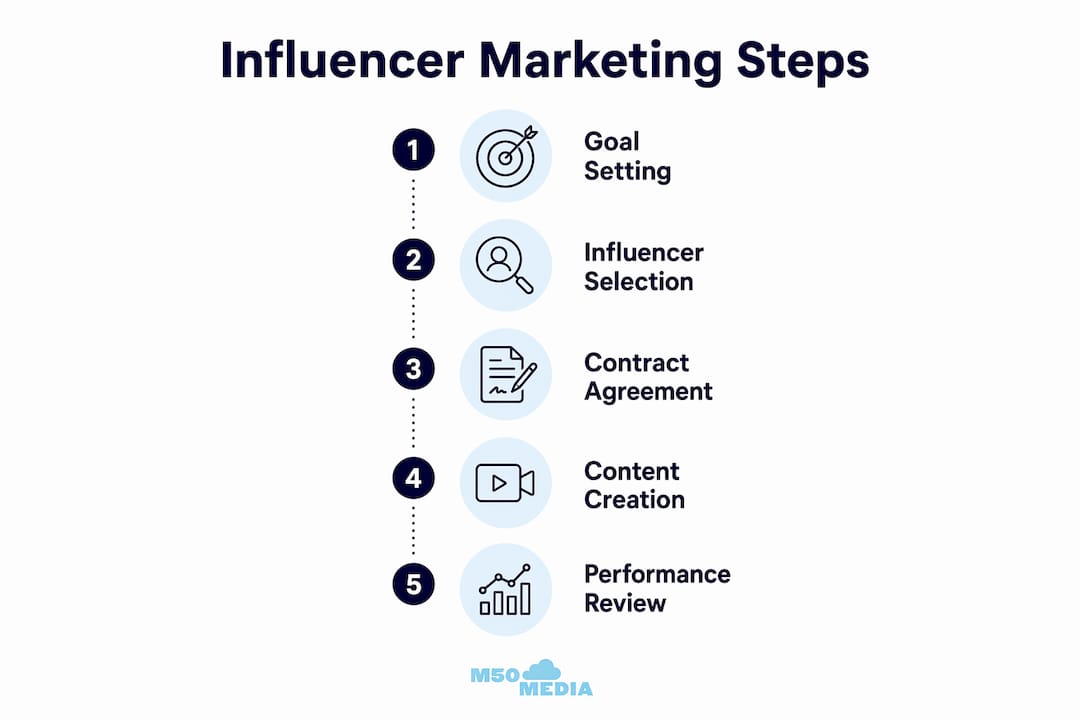
A solid influencer marketing strategy follows a five-step workflow, and skipping any step is like baking a cake without flour. You can try, but nobody’s going to enjoy the result. Shopify Canada recommends structuring campaigns from initial planning all the way through to scaling, and that structure is exactly what separates brands that get results from brands that just get invoices.
Here is the workflow:
Set clear goals aligned with your budget. Are you chasing brand awareness, website traffic, or direct sales? Pick one primary objective before you spend a single dollar. A small business with a $500 budget needs a very different campaign than one with $5,000.
Identify and vet influencers by niche, engagement, and authenticity. Effective vetting focuses on niche fit and clear contract terms rather than raw follower numbers. A creator with 8,000 highly engaged followers in your exact product category will outperform a celebrity with 800,000 distracted ones.
Develop your outreach and compensation model. Options include flat-fee payments, affiliate commissions, product gifting, or long-term ambassador arrangements. Each has trade-offs. Flat fees give you predictability; affiliate models tie pay to performance.
Co-create content collaboratively. This is where most small businesses go wrong. They hand over a script tighter than a Terms and Conditions agreement and wonder why the content feels robotic. Giving creators creative freedom and building long-term relationships improves ROI and authenticity. Let them speak in their own voice.
Measure ROI and scale what works. Use UTM links, unique discount codes, and content volume tracking to attribute results. Then double down on the creators and formats that performed.
Pro Tip: Before you finalise payment structures, lock down deliverables and usage rights in your contract. Shopify recommends finalising expectations first to avoid operational friction down the road.
Step | What to do |
Goal setting | Define one primary metric before any outreach begins |
Influencer vetting | Prioritise niche fit and engagement over follower count |
Compensation | Match payment model to campaign goals and budget |
Content creation | Collaborate with creators; avoid over-scripting |
Measurement | Use UTM links and discount codes to track real ROI |
How to evaluate and compare influencers effectively

Not all influencers are created equal, and comparing them without context is like comparing a hockey score to a cricket score. The numbers mean completely different things depending on the game. Engagement benchmarks vary widely by platform, and comparing rates across platforms without adjustment leads to poor influencer choices.
Here is what you need to know about platform differences:
TikTok’s median engagement rate is roughly double Instagram’s across all follower tiers, partly because TikTok calculates engagement using views in the denominator while Instagram uses followers. This means a TikTok creator with a 4% rate and an Instagram creator with a 2% rate may actually be performing at equivalent levels for their respective platforms. Always compare influencers within the same platform and the same follower tier.
Beyond the numbers, here is a quick breakdown of influencer types and what they offer:
Influencer type | Follower range | Pros | Cons |
Nano | 1,000 to 10,000 | High trust, affordable, niche audiences | Limited reach |
Micro | 10,000 to 100,000 | Strong engagement, cost-effective | Slower brand awareness growth |
Macro | 100,000 to 1M | Broad reach, professional content | Higher cost, lower engagement rates |
Mega/Celebrity | 1M+ | Massive visibility | Expensive, less authentic feel |
For most small businesses, nano and micro influencers are the sweet spot. They are affordable, their audiences trust them like a neighbour recommending a plumber, and their engagement rates tend to be genuinely strong.
When vetting any creator, look at these factors:
Audience demographics (age, location, interests) and whether they match your customer profile
Comment quality (real conversations vs. generic emoji spam)
Posting consistency and content quality over the past three to six months
Any past brand partnerships and whether those felt authentic or forced
You can use platforms like UpPromote to manage affiliate-style influencer relationships, or tools like Modash and Creator.co to search and vet creators by niche. The goal is finding someone whose audience already wants what you sell. Check out this M50media resource on influencer marketing for small businesses for a deeper look at the vetting process.
What legal and ethical guidelines must you follow?
The FTC (Federal Trade Commission) requires clear and conspicuous disclosure whenever there is a material connection between an influencer and a brand. That means paid posts, gifted products, and affiliate relationships all need to be disclosed. No exceptions, no loopholes, no burying it in a wall of hashtags.
“Disclosures must be obvious at scrolling speed and cannot be hidden behind ‘more’ buttons or unclear hashtags like #sp or #collab.” — FTC Endorsement Guides
What does proper disclosure actually look like? A clear “#Ad” or “#Sponsored” at the very beginning of a caption. A verbal mention in the first few seconds of a video. Not buried in a list of 30 hashtags. Not in a font size that requires a magnifying glass. Both brands and influencers can be liable for deceptive endorsement if disclosures are inadequate, which means you cannot simply hand off responsibility to the creator and hope for the best.
Disclosure placement should be integrated as a creative constraint from the start, not an afterthought tacked on after the content is filmed. Build it into your creative brief. Specify exactly where and how the disclosure must appear. Make it a non-negotiable part of your contract.
Pro Tip: Include a disclosure checklist in every influencer contract. Specify the exact wording, placement, and timing required for each content format (Instagram post, Reel, TikTok video, YouTube integration). This protects both you and the creator.
Brands should also implement monitoring programmes to review published content before it goes live when possible, and certainly after posting. Brands that implement training and monitoring programmes for compliance are far less likely to face regulatory headaches. Think of it as the seatbelt of your influencer campaign. Slightly inconvenient, but you will be very glad it is there.
How to measure, analyse, and optimise influencer campaign performance
Measuring influencer marketing success starts with choosing a “north star” metric before your campaign launches. Choosing a north star metric aligned with your business goals helps you avoid chasing vanity metrics and supports better ROI measurement. Vanity metrics (likes, impressions, follower gains) feel good but rarely tell you whether the campaign actually moved the needle for your business.
Here is how to match your metric to your goal:
Sales goal: Track via unique discount codes or UTM-tagged links in bio. Every conversion is directly attributable.
Traffic goal: Use UTM parameters in Google Analytics 4 to measure sessions, bounce rate, and time on page from influencer sources.
Brand awareness goal: Track reach, share of voice, and content volume. How many pieces of user-generated content did the campaign produce?
Community growth goal: Monitor follower growth rate and direct message volume during and after the campaign period.
Selecting the right attribution method before launch is the difference between meaningful data and a spreadsheet full of guesses. Set it up before the campaign goes live, not after.
Avoid the trap of metric cherry-picking. If your campaign drove 50,000 impressions but zero clicks, reporting only impressions is the marketing equivalent of telling your boss you showed up to work but not mentioning you slept through the whole meeting. Report the full picture, learn from it, and adjust.
Ongoing partnerships outperform one-off campaigns in both ROI and authenticity. When you find a creator whose audience genuinely responds to your product, build the relationship. Repeat collaborations build familiarity and trust with that creator’s audience over time. Think of it like a TV series versus a one-time special. The series always wins. For inspiration on what strong campaigns look like in practice, the M50media article on social media campaign examples is worth a read.
Key takeaways
Influencer marketing works best when you combine a structured five-step strategy, niche-fit creator selection, FTC-compliant disclosures, and a pre-defined north star metric to measure real business outcomes.
Point | Details |
Strategy before spending | Set one clear goal and vet influencers by niche fit before any outreach begins. |
Platform context matters | Compare engagement rates only within the same platform and follower tier. |
Compliance is non-negotiable | FTC disclosures must be clear, conspicuous, and built into your creative brief and contract. |
Measure what matters | Choose your attribution method before launch to avoid vanity metric traps. |
Long-term beats one-off | Ongoing influencer relationships consistently outperform single-campaign partnerships. |
What I have learned from watching small businesses do this (and get it wrong)
Here is my honest take after years of working with small business owners on their digital marketing: the biggest mistake is not picking the wrong influencer. It is treating influencer marketing like a vending machine. You put money in, you expect a sale to pop out immediately, and when it does not happen in week one, you pull the plug.
Influencer marketing is more like planting a garden than operating a vending machine. The first campaign teaches you something. The second one teaches you more. By the third, you actually know what you are doing. I have seen small businesses get genuinely transformative results from micro-influencer campaigns, but almost never on the first try.
The other thing I keep seeing is over-scripted content. A brand sends a creator a 400-word script, a mood board, three rounds of revisions, and then wonders why the video feels like a hostage situation. Allowing creators voice autonomy within your campaign goals yields higher trust and better content performance. Give them the key messages and the disclosure requirements. Then get out of the way.
Start small, stay consistent, and treat your best-performing creators like the business partners they genuinely are. The brands that win at this are the ones that build real relationships, not just transactional ones. And yes, that takes time. But so does anything worth doing.
— Karl
Ready to launch your influencer strategy?
If you have made it this far, you are already ahead of most small business owners who are still Googling “what is an influencer” at midnight. (No judgement. We have all been there.) M50media offers digital marketing coaching tailored specifically to small business owners who want to build real, results-driven influencer campaigns without the guesswork.
Karl works directly with business owners to map out influencer strategies, set up attribution systems, and build the kind of creator relationships that actually move the needle. If you want personalised guidance on where to start, book a free Marketing SOS call and let’s figure out your next move together. No pressure, no jargon, just practical help from someone who has done this before.
FAQ
What is influencer marketing in simple terms?
Influencer marketing is when a brand partners with a social media creator to promote its products or services to that creator’s audience. The creator’s existing trust with their followers is what makes the promotion effective.
How do I find the right influencer for my small business?
Focus on niche fit and audience demographics rather than follower count. A micro-influencer with 15,000 engaged followers in your product category will typically outperform a celebrity with millions of unrelated followers.
What platforms work best for influencer marketing?
TikTok and Instagram are the most widely used platforms for influencer campaigns in 2026. TikTok tends to deliver higher engagement rates, while Instagram offers stronger options for product-focused content and shopping integrations.
Do I legally have to disclose paid influencer partnerships?
Yes. The FTC requires clear and conspicuous disclosure for any material connection between a brand and a creator, including paid posts, gifted products, and affiliate arrangements. Both the brand and the influencer can face liability for non-compliance.
How do I know if my influencer campaign is working?
Choose one primary metric before the campaign launches, such as sales tracked via discount codes, traffic measured through UTM links, or content volume for awareness goals. Measuring against a pre-defined benchmark is the only way to know if the campaign delivered real value.
Recommended
Comments