Lead generation strategies for small business: 2026 guide

TL;DR:
Effective lead generation combines targeted content, outreach, and data-driven tools to attract qualified prospects and convert them into customers. Small businesses should adopt a systematic approach, using multiple channels and automation, to build a sustainable, high-quality pipeline over time. Patience and continuous iteration are essential for long-term success in capturing and nurturing leads.
Lead generation strategies are the marketing and sales activities that systematically attract qualified prospects and convert them into paying customers. Think of them as the engine under the hood of your business growth. Without a real system in place, you’re basically hoping customers wander in like lost tourists. The good news? You don’t need a massive budget or a full marketing department. You need the right tactics, the right tools, and a process that actually runs. This guide covers the best lead generation tactics available to small businesses right now, from SEO-optimised content and webinars to CRM workflows and multi-channel orchestration.
What are the most effective lead generation strategies for small businesses?
The most effective lead generation strategies combine valuable content, targeted outreach, and data-driven tools to attract and convert prospects. That’s not a vague platitude. It’s a recipe with specific ingredients. Here’s what actually moves the needle for small businesses in 2026.

Content mapped to the buyer journey is the foundation of any solid inbound marketing strategy. You create blog posts and social content for people who are just discovering their problem (top of funnel, or TOFU). You offer whitepapers, case studies, and comparison guides for people actively evaluating solutions (middle of funnel, MOFU). You close with testimonials, demos, and free trials at the bottom (BOFU). Each piece of content serves a purpose. Nothing is random.
Gated assets are one of the best lead generation tactics for capturing contact information. A well-crafted whitepaper, checklist, or template sits behind a simple form. The visitor gets something genuinely useful. You get a qualified lead. Win-win, like finding a parking spot right in front of the store.
Webinars and virtual events are seriously underrated. Webinars convert registrants to attendees at 20–40%, and attendees to qualified leads at 5–15%. That’s a meaningful conversion rate for a free event. Follow up within 24 hours with personalised outreach and that number climbs even higher.
Here are more tactics worth adding to your lead generation strategies list:
Social selling on LinkedIn: Connect with decision-makers directly, share insights, and build relationships before pitching anything. LinkedIn is the B2B lead generation playground.
Targeted paid campaigns: Google Ads and Meta Ads let you reach specific audiences with precision. Pair them with a strong landing page and a clear offer.
Native advertising: Sponsored content on platforms like Taboola or Outbrain blends into editorial feeds and attracts readers who are already in a learning mindset.
Visitor identification tools: Tools like Leadfeeder show you which companies are visiting your website even when they don’t fill out a form. That’s warm outreach gold.
Pro Tip: Don’t launch every tactic at once. Pick two or three channels, run them well for 90 days, measure results, then expand. Spreading yourself thin is the fastest way to generate zero leads from ten strategies.
Which tools and workflows should you use?
The right tools turn your lead generation ideas into a repeatable system. Without them, you’re manually chasing every lead like a golden retriever after a tennis ball. Exhausting and not very scalable.
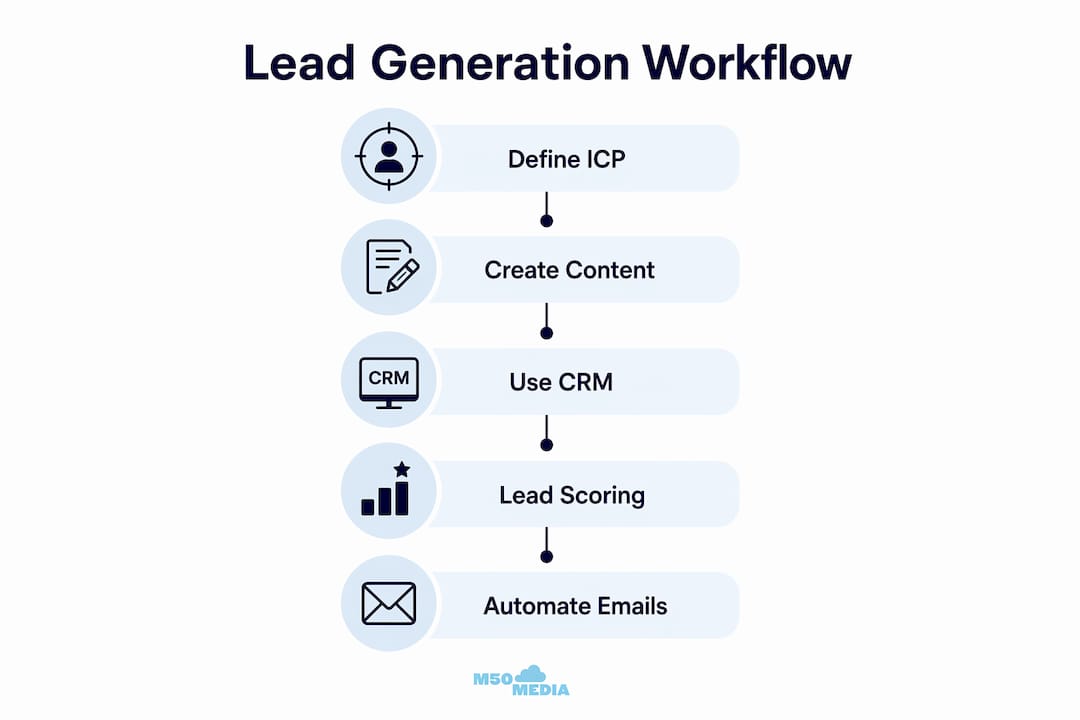
The table below outlines the core tools and their roles in an effective lead generation workflow.
Tool Category | Example Tools | Primary Role |
CRM Platform | monday CRM, HubSpot | Centralise lead data and track pipeline stages |
Visitor Identification | Leadfeeder | Identify anonymous website visitors by company |
Marketing Automation | Mailchimp, ActiveCampaign | Automate nurture sequences and follow-ups |
Lead Scoring Software | HubSpot, Marketo | Qualify leads before sales handoff |
Landing Page Builders | Unbounce, Leadpages | Capture leads from paid and organic traffic |
Lead scoring is the piece most small businesses skip, and it costs them. Effective scoring weighs fit metrics like company size and industry at 60%, and engagement metrics like page visits and email interactions at 40%. That balance tells you who is the right type of customer AND who is actually interested. Sales teams love getting leads that already meet both criteria.
Integrating marketing and sales workflows is equally critical. Many businesses fail because they assume leads will appear without a systematic process. Marketing generates the lead. The CRM captures it. Automation nurtures it. Sales receives it when it hits a qualifying score. That handoff needs to be clean, or leads fall through the cracks like change down the back of a couch.
Pro Tip: Set up automated lead capture workflows in your CRM from day one. Even a basic sequence of three to five emails saves hours of manual follow-up every week.
How do you execute lead generation step-by-step?
Knowing the tactics is one thing. Putting them into motion is another. Here’s a practical sequence that works for small businesses without a dedicated marketing team.
Define your Ideal Customer Profile (ICP). Who is your best customer? What industry are they in? What problems keep them up at night? The more specific you are, the more targeted your content and outreach will be. Vague targeting produces vague results.
Map your buyer’s journey. Identify the questions your ideal customer asks at each stage, from first realising they have a problem to deciding which solution to buy. Every piece of content you create should answer one of those questions.
Create targeted lead magnets. Build one strong gated asset for each funnel stage. A practical checklist works well at TOFU. A detailed comparison guide works at MOFU. A free consultation or demo offer works at BOFU.
Design your nurture sequence. Content mapped to buyer journey stages with a sustainable cadence, like one email per week in B2B, balances engagement without fatiguing your list. Each email should deliver standalone value, not just a sales push. Think of it as being a helpful colleague, not a pushy salesperson.
Distribute through SEO and social media. Publish your content where your ICP already spends time. Optimise blog posts for search. Share on LinkedIn. Repurpose into short videos or carousel posts. Social media advertising amplifies reach when organic growth is slow.
Measure and iterate. Track conversion rates at every stage of your funnel. Where are leads dropping off? Which content pieces generate the most form fills? The most effective lead generation systems require ongoing iteration rather than isolated tactic tweaks.
Avoid treating lead generation as a static checklist. The businesses that win are the ones that treat it as a living system, reviewing funnel performance monthly and adjusting based on real data rather than gut feelings.
A common pitfall is launching a campaign, getting mediocre results, and abandoning the whole approach. Most lead generation funnels need 60–90 days of data before you can draw meaningful conclusions. Patience is a strategy too.
How does a multi-channel approach improve lead quality?
Relying on a single channel for lead generation is like fishing with one hook in a lake full of fish. You might catch something, but you’re leaving a lot on the table. Combining content marketing, social selling, email outreach, and conversational marketing is more effective than any single-channel approach. Each channel fills a different gap in the buyer journey.
Here’s how single-channel and multi-channel approaches compare:
Approach | Strengths | Weaknesses |
Single channel (e.g., SEO only) | Low cost, compounding returns | Slow to start, vulnerable to algorithm changes |
Single channel (e.g., paid ads only) | Fast results, precise targeting | Stops working the moment you stop spending |
Multi-channel coordinated | Covers full buyer journey, builds trust | Requires more planning and consistent execution |
Inbound content marketing compounds leads over time, unlike paid ads that stop delivering the moment your budget runs out. That’s the core argument for building a multi-channel system that includes both organic and paid components.
Multi-channel also means your brand shows up consistently wherever your prospect is looking. They read your blog post on Monday, see your LinkedIn post on Wednesday, and get your nurture email on Friday. By the time they’re ready to buy, you’re the obvious choice. That’s not luck. That’s orchestration.
Social proof and external validation surfaced at every touchpoint increase trust and conversion rates. Weave testimonials and case studies into your emails, landing pages, and social posts. Don’t save them for the sales call. Trust builds incrementally, and every touchpoint is an opportunity to reinforce it.
AI is also changing how small businesses handle lead scoring and personalisation at scale. Tools are getting better at predicting which leads are most likely to convert based on behavioural signals, saving you time and helping you focus energy where it counts.
Key takeaways
The most effective lead generation system combines multi-channel content, automated workflows, and consistent measurement to attract and convert qualified prospects at every stage of the buyer journey.
Point | Details |
Build a system, not a campaign | Treat lead generation as an ongoing process with regular funnel audits and iteration. |
Map content to buyer stages | Create TOFU, MOFU, and BOFU assets that answer specific questions at each journey stage. |
Score leads before handoff | Weight fit metrics at 60% and engagement metrics at 40% for better sales-ready leads. |
Use multi-channel coordination | Combine SEO, social selling, email, and paid ads to cover every gap in the buyer journey. |
Nurture with standalone value | Send one email per week maximum in B2B, and make every message worth reading on its own. |
Karl’s take: lead generation is a system, not a sprint
Here’s something I see constantly with small business owners: they launch a lead generation campaign, wait three weeks, get frustrated, and pivot to something completely different. Rinse and repeat. It’s the marketing equivalent of starting a new diet every Monday.
The businesses I’ve worked with that actually grow their pipeline treat lead generation as an engineered system. Technology, trust-building, and storytelling all work together. You can’t just bolt on a landing page and call it a strategy. You need the CRM capturing data, the content building credibility, and the nurture sequence doing the relationship work over time.
The other thing I’ll say is this: automation is your friend, but it can’t replace genuine connection. The best results I’ve seen come from businesses that automate the repetitive stuff (follow-up emails, lead scoring, pipeline updates) and then show up personally for the high-value conversations. That balance is where the magic happens.
Early wins matter too. A 90-day pilot programme focused on one or two channels gives you real data and builds internal confidence. Once you see leads coming in consistently, it’s much easier to invest more time and budget into expanding the system. Start small, prove it works, then scale it up.
— Karl
Ready to build a lead generation system that actually works?
If reading this article felt like drinking from a fire hose (in the best possible way), you’re not alone. Pulling all of these pieces together takes time, expertise, and a clear plan tailored to your specific business.
M50media offers personalised coaching and digital marketing services designed specifically for small business owners who want to stop guessing and start growing. Whether you need help building your first lead generation funnel, setting up your CRM workflows, or figuring out which channels are worth your time, Karl can help you cut through the noise and build something that actually delivers results. Book a free Marketing SOS call and let’s figure out your next move together.
FAQ
What is lead generation in simple terms?
Lead generation is the process of attracting potential customers and collecting their contact information so you can follow up and convert them into paying clients. It combines content, outreach, and tools to build a steady pipeline of qualified prospects.
How do i start generating leads for my small business?
Start by defining your Ideal Customer Profile, then create one strong lead magnet (like a checklist or guide) and a simple landing page. Drive traffic through SEO or a small paid campaign, and set up a basic email nurture sequence to follow up automatically.
How many lead generation channels should i use?
Start with two or three channels and run them consistently for at least 90 days before expanding. Combining multiple channels reduces gaps in the buyer journey and improves overall lead quality compared to relying on a single source.
What is lead scoring and why does it matter?
Lead scoring assigns point values to prospects based on how well they fit your ideal customer profile and how engaged they are with your content. It helps your sales team focus on the leads most likely to convert, rather than chasing every contact equally.
How long does it take to see results from lead generation?
Most lead generation funnels need 60–90 days of consistent execution before producing reliable data. Inbound content marketing compounds over time, so the results grow steadily rather than appearing overnight.
Recommended
Comments