Startup branding process: Build a standout identity in 5 steps

TL;DR:
Branding involves a structured process of discovery, strategy, verbal and visual identity, and activation.
Proper preparation and professional guidance are crucial, especially for visual identity development.
Measuring branding impact through specific metrics helps startups refine and improve their brand over time.
Most startup founders know their product inside and out. But when it comes to branding? Total deer-in-headlights moment. 🦌 You’ve got a great idea, a scrappy team, and approximately zero clarity on how to make your business look and feel like something people actually trust. Sound familiar? The good news is that branding doesn’t have to feel like assembling IKEA furniture without the instructions. There’s a real, repeatable process that takes you from “who are we?” to “oh wow, I love this brand” and we’re walking you through every phase of it right here.
Table of Contents
Key Takeaways
Point | Details |
Branding follows clear phases | A structured five-phase process ensures your brand stands out and grows sustainably. |
Preparation saves time and cost | Gathering tools, resources, and the right team before starting will prevent costly mistakes. |
Execution needs discipline | Following each branding step in sequence leads to a strong and authentic identity. |
Measure and refine | Track key metrics after launch and adjust your brand based on real feedback. |
Understanding the branding process: Phases and timeline
Let’s get one thing straight: branding is not just picking a logo colour and calling it a day. It’s a structured journey, and skipping steps is like skipping leg day. You might feel fine at first, but eventually it catches up with you.
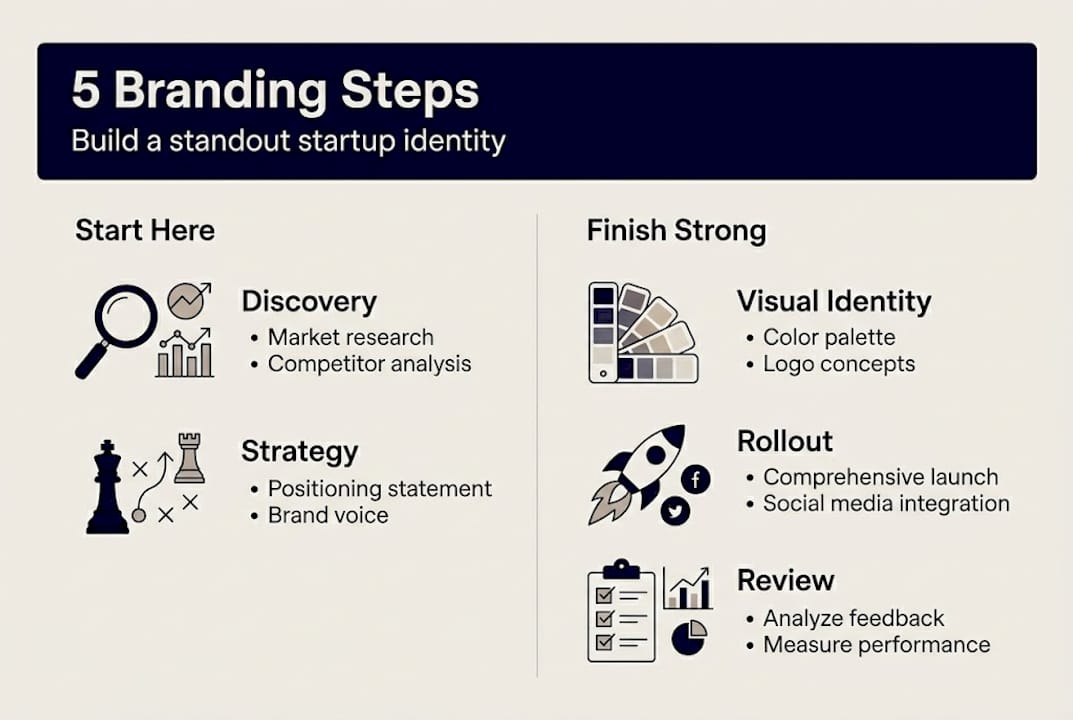
According to brand building for startups, the branding process follows a structured 4 to 5 phase methodology that looks like this:
Phase | Focus | Typical timeframe |
1. Discovery | Customer, competitor, and market research | 2 to 4 weeks |
2. Strategy | Positioning, purpose, values, vision | 2 to 3 weeks |
3. Verbal identity | Messaging, tone of voice, naming | 2 to 4 weeks |
4. Visual identity | Logo, colours, typography | 4 to 8 weeks |
5. Activation | Brand guidelines and rollout | 4 to 8 weeks |
So yes, you’re looking at roughly 14 to 27 weeks for the full ride. That might feel like a long time, but rushing it is how you end up with a rebrand six months later (expensive, exhausting, and very avoidable).
Here’s what each phase actually delivers:
Discovery: Customer personas, competitor audit, market positioning map
Strategy: Brand platform document with your purpose, values, and vision
Verbal identity: Tagline, messaging pillars, tone of voice guide
Visual identity: Logo suite, colour palette, typography system
Activation: Brand guidelines PDF, launch plan, social templates
Understanding branding’s role in loyalty is also key here because each phase builds on the last. If you skip Discovery, your Strategy is just guesswork. And if your Strategy is guesswork, your Visual Identity is basically a fancy guess in a nice font.
Pro Tip: Don’t rush to the “fun” visual phase before your strategy is locked in. Designers need direction, not vibes. Getting your digital branding basics sorted before you open Canva will save you weeks of back-and-forth.
How to prepare: Tools and resources you need for branding
Okay, so you know the phases. Now let’s talk about showing up prepared. Walking into a branding process without the right tools is like showing up to a potluck with an empty dish. Awkward for everyone.
Every stage of branding benefits from dedicated research, design, and communication tools. Here’s a quick comparison of what you’ll need across phases:
Phase | Free tools | Paid/pro tools |
Discovery | Google Forms, SurveyMonkey (free tier) | SEMrush, Typeform |
Strategy | Google Docs, Notion | Miro, Confluence |
Verbal identity | Hemingway App, ChatGPT | Jasper, Grammarly Pro |
Visual identity | Canva (free), Coolors | Adobe Creative Suite, Figma |
Activation | Google Drive, Trello | Brandfolder, Frontify |
Beyond software, you’ll want to gather a few key documents before you start:
A clear description of your target customer (even a rough one)
A list of 5 to 10 competitors and what you think of their brands
Your business goals for the next 12 to 24 months
Any existing brand assets (even if you hate them)
A realistic budget for design and copywriting
As for people, you’ll ideally want a brand strategist, a graphic designer, and a copywriter involved at various stages. That said, not every startup has the budget for a full team right away. And that’s okay!

Pro Tip: DIY the Discovery and Strategy phases using free tools and your own research. But when it comes to Visual Identity, seriously consider hiring a professional designer. A botched logo is the branding equivalent of a bad haircut. Everyone notices, nobody says anything, and it takes forever to grow out. Check out this marketing checklist for startups to make sure you’re not missing any prep steps, and use step-by-step marketing planning to align your branding with your broader marketing goals from day one.
Walking through each branding step: Execution guide
Alright, tools in hand, coffee in cup. Let’s actually do this thing. Here’s your step-by-step execution guide for each branding phase, with real startup actions and the mistakes you absolutely want to avoid.
Warning: Skipping Discovery or copying a competitor’s brand is the fastest way to build something that looks like a knockoff. Customers can smell inauthenticity from a kilometre away. Don’t do it.
Following a step-by-step process produces a stronger, more enduring outcome. Here’s how to actually execute each phase:
Discovery: Interview at least 10 potential customers. Run a competitor audit. Map out where your brand can genuinely stand out. Mistake to avoid: relying only on your own opinions about your audience.
Strategy: Write your brand platform. This includes your purpose (why you exist beyond profit), your values (how you behave), and your vision (where you’re headed). Mistake to avoid: being vague. “We value integrity” means nothing. “We never overpromise, even when it costs us” means everything.
Verbal identity: Develop your messaging pillars and tone of voice. Write sample copy in your brand voice for social media, your website homepage, and an email. Mistake to avoid: writing in corporate-speak when your audience wants a real conversation.
Visual identity: Brief your designer with your brand platform and verbal identity. Review concepts with your target audience, not just your team. Mistake to avoid: choosing what YOU like instead of what resonates with your customer.
Activation: Build your brand guidelines document and roll out consistently across every channel. Mistake to avoid: launching on three platforms at once with three different looks.
For more on building your brand online and nailing your brand positioning strategies, we’ve got you covered with deeper dives into both.
Pro Tip: Create a simple one-page brand summary card once your strategy is done. Pin it somewhere your whole team can see it. Consistency starts with everyone being on the same page. Literally.
Verifying your brand: Measuring results and adjusting
You’ve done the work. You’ve launched. Now what? You sit back and wait for the customers to roll in like a Netflix rom-com ending? Not quite. You need to measure whether your branding is actually landing.
Measuring the impact of your branding allows you to refine and adjust for better market response. Here’s what to track:
Brand awareness: Are more people searching for your business name? Track branded search volume in Google Search Console.
Engagement rate: Are social media followers actually interacting with your content, or just scrolling past?
Customer inquiries: Are the right kinds of customers reaching out? Quality matters as much as quantity.
Net Promoter Score (NPS): Are existing customers recommending you to others?
Website bounce rate: Are visitors sticking around or leaving faster than a bad first date?
Statistic callout: Most brands start seeing measurable engagement improvements within 3 to 6 months of a consistent rollout, with trust indicators like repeat visits and referrals building more strongly at the 6 to 12 month mark.
Feedback loops are your best friend here. Send short surveys to new customers asking how they heard about you and what made them choose you. Monitor your reviews. Pay attention to the language your customers use to describe you because sometimes they’ll nail your positioning better than you did.
Know when to tweak. If your messaging isn’t converting, test a new angle. If your visual identity feels off after six months, a small refresh (not a full rebrand) might be all you need. Leaning into blogs and brand visibility and consistent content creation for branding can also dramatically accelerate how quickly your brand builds recognition.
Pro Tip: Set a 90-day branding review in your calendar right after launch. Check your metrics, gather feedback, and make one small adjustment. Don’t overhaul everything at once. Small, informed tweaks beat dramatic pivots every time.
What most startups get wrong about branding (and how to fix it)
Here’s the uncomfortable truth that most branding guides won’t tell you: the biggest branding mistakes aren’t design mistakes. They’re thinking mistakes.
Too many startups look at a brand they admire (say, Apple or Patagonia) and try to reverse-engineer the vibe without doing the foundational work. The result? A brand that looks polished on the surface but feels hollow the moment a customer interacts with it. It’s like putting a designer suit on someone who hasn’t figured out who they are yet. The suit doesn’t fix the identity crisis.
Consistency and authenticity outperform surface-level design every single time. A brand that shows up the same way across every touchpoint, with a clear point of view and genuine personality, will always outperform a prettier brand that’s all over the place.
Small tweaks informed by real customer feedback have an outsized impact. You don’t need a massive rebrand. You need honest reflection and small, deliberate improvements. That’s where real marketing strategy insights come from: not from copying what’s trending, but from understanding what your specific audience actually needs.
Ready to build your standout startup brand?
If you’ve made it this far, you’re already ahead of most founders who are still Googling “what is a brand” at midnight. 🎉 You know the process, you’ve got the tools, and you understand what to measure.
But knowing and doing are two very different things. If you want personalised guidance on where to start, what to prioritise, and how to avoid the most common (and costly) branding mistakes, we’re here for it. Book a free Marketing SOS call with Karl and get straight-talking advice tailored to your startup. And if you’re looking for the right software to support each phase, check out our curated list of top branding tools to find what fits your budget and goals.
Frequently asked questions
How long does it take to build a startup brand?
A full branding process typically takes 12 to 21 weeks, depending on team size, budget, and how many phases you’re tackling at once.
What is the most important phase of the branding process?
Discovery is the most crucial phase because it sets the foundation for every strategic and creative decision that follows. Skip it and you’re building on sand.
How do I know if my branding is working?
Look for increased branded searches, customer engagement, and referrals. Measuring branding impact consistently lets you refine your approach for better market response over time.
Can I do startup branding myself or should I hire an expert?
You can DIY the early phases using free tools, but dedicated branding tools and expertise significantly improve outcomes, especially for visual identity and strategy work.
Recommended
Comments