Local SEO: attract nearby customers and grow faster
TL;DR:
Local SEO optimizes small businesses’ visibility in nearby search results, attracting ready-to-buy customers.
Key factors include accurate information, positive reviews, and consistent citations across platforms.
Regular engagement through profile updates, review responses, and local content sustains long-term local search success.
You’ve got a great business, a solid product or service, and customers who would absolutely love you — if only they could find you. Here’s the thing: SEO isn’t one-size-fits-all. Most people picture SEO as some mystical internet sorcery designed for giant e-commerce empires or tech startups in Silicon Valley. But if you run a local business, whether it’s a bakery, a plumbing service, or a yoga studio, there’s a whole other game being played. It’s called local SEO, and it’s basically your business’s GPS signal to the people searching for you right now, just a few streets away. 🗺️
Table of Contents
Key Takeaways
Point | Details |
Local SEO targets nearby customers | Local SEO connects your business with people searching in your geographic area, increasing the chances of attracting local clients. |
Google uses relevance, distance, and prominence | Those three factors determine where your business shows up in local search results and Google Maps. |
Optimise profiles and gather reviews | Claim your Google Business Profile, use correct information, and encourage customer reviews to boost your ranking. |
Monitor and adapt for ongoing success | Track your performance, respond to customer feedback, and keep your listings updated for continuous local SEO improvement. |
Understanding local SEO: The basics for small businesses
So what exactly is local SEO? Think of it like the difference between shouting your business name into the void of the internet versus whispering it directly into the ear of someone standing on your street corner asking, “Where’s a good coffee shop around here?” Local SEO is the practice of optimising your online presence so that your business shows up when people nearby search for what you offer.
Unlike traditional SEO, which is essentially a global or national popularity contest (think major media sites, big brand blogs, and massive product pages all duking it out for the top spot), local SEO is hyper-focused. It’s about your neighbourhood, your city, your community. If you’re a dentist in Halifax or a florist in Kelowna, you don’t need to outrank every dentist or florist in the country. You just need to beat the ones down the road.
Here’s why this matters so much for small businesses:
People searching locally are often ready to buy. These aren’t casual browsers. Someone searching “pizza near me” at 6:30 PM is making a decision, fast.
Local search results appear prominently in Google, often above regular website results, especially on mobile.
You don’t need a massive marketing budget to compete. Smart local SEO levels the playing field between you and larger competitors.
Local SEO builds long-term trust and visibility in your community, which compounds over time.
Now, why invest in SEO at all if you’re a small local business? The answer is pretty straightforward: your customers are already searching online, and if you’re not showing up, someone else is scooping them up instead.
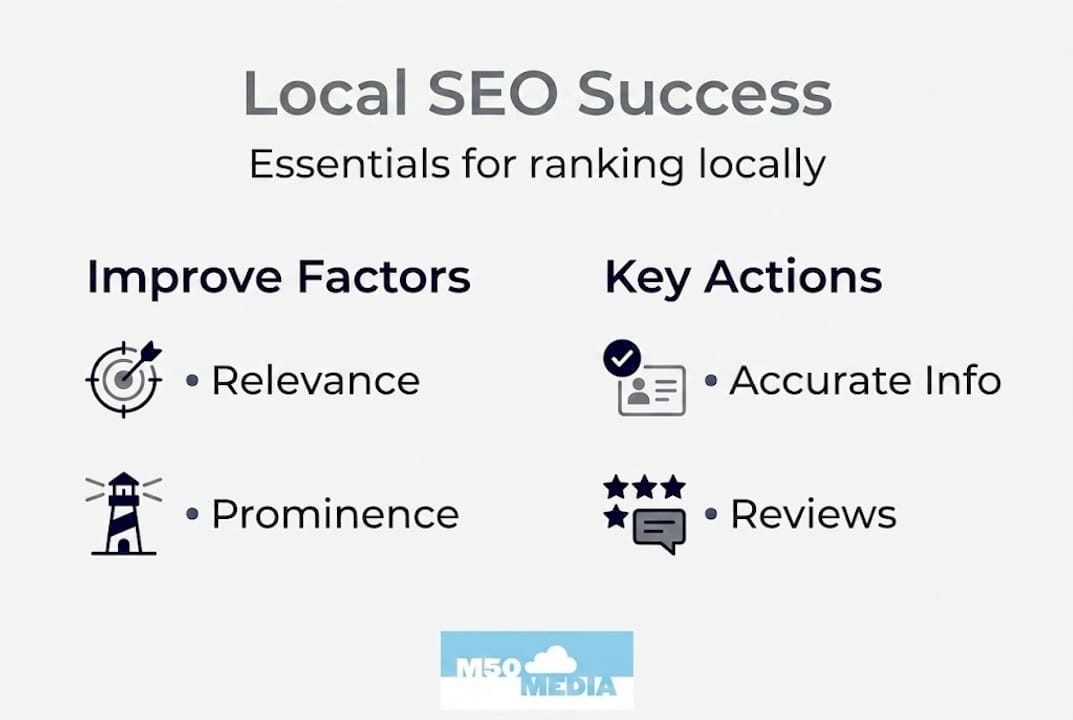
Google’s local search algorithm primarily uses three factors: Relevance, Distance, and Prominence. Relevance is about how well your business matches what someone searched for. Distance is about how far your business is from the searcher (or the location they specified). Prominence is about how well-known and reputable your business is online. These three pillars are what the entire local SEO game is built around.
Pro Tip: Don’t wait until your business is struggling to think about local SEO. Start building your online presence now so that when people search, you’re already there waiting for them like a friendly shop owner who always has the door open.
Understanding these fundamentals is like finally reading the manual after trying to assemble flat-pack furniture for two hours. Suddenly, everything clicks.
How Google determines local search results
Alright, let’s get into the good stuff. Once you know that Google uses Relevance, Distance, and Prominence to rank local businesses, the next logical question is: what does that actually mean for your business day-to-day?
Here’s a breakdown in plain English:
Ranking factor | What it means | How to improve it |
Relevance | Does your business match what the user searched for? | Use accurate categories, keywords, and descriptions in your profile |
Distance | How close is your business to the searcher? | Accurate address info and serving local areas clearly listed |
Prominence | How well-known and trusted is your business online? | Earn reviews, build citations, and get mentioned across reputable sites |
These three ranking factors interact with each other constantly. A business that’s further away but has hundreds of glowing reviews might outrank a closer competitor with no online presence at all. It’s not purely about geography. It’s about the full picture Google sees when it looks at your business online.
Let’s talk about customer reviews for a moment, because this is where so many small businesses drop the ball. Reviews are one of the most direct signals Google uses to assess prominence. Not just the number of reviews, but the quality, recency, and how you respond to them. A business with 200 reviews that actively engages with customers is going to signal way more trust than one with 15 reviews from three years ago and zero responses.

Managing your reviews and reputation online is genuinely one of the highest-return activities you can do for local SEO. It’s free (mostly), it builds community trust, and Google eats it up.
Here are the key things that signal prominence to Google:
Number and quality of customer reviews across Google, Yelp, and industry-specific platforms
Mentions of your business on other reputable websites (called citations)
Your presence and consistency across directories like Yellow Pages, Bing Places, and Apple Maps
Links from local news sites, community blogs, or partner businesses
Here’s a stat worth chewing on: studies consistently show that nearly half of all Google searches have local intent. Half! That’s an enormous audience of people actively looking for businesses like yours, in areas like yours, right now. If your business information is inaccurate, incomplete, or simply missing, you are essentially invisible to them. And nobody wants to be the ghost that doesn’t know they’re a ghost. 👻
The bottom line here is that accuracy, engagement, and consistency are your best friends when it comes to ranking in local search results.
Core local SEO strategies: Steps to boost your visibility
Okay, you understand the theory. Now let’s actually do something about it. Here are the core strategies, in order of priority, to boost your local SEO and start showing up where it counts.
Claim and optimise your Google Business Profile. This is the single most important thing you can do. Your Google Business Profile (formerly Google My Business) is what powers your appearance in Google Maps and the local “3-pack” (those three highlighted businesses at the top of local search results). Fill in every field: business name, address, phone number, hours, website, photos, services, and category. Do not leave anything blank.
Nail your NAP consistency. NAP stands for Name, Address, Phone number. These details need to be identical everywhere online: your website, your Google profile, every directory listing. Even small differences (like “Street” versus “St.”) can confuse Google and hurt your rankings. It sounds fussy, but it matters.
Build local citations. A citation is any mention of your business online, even if it’s not a link. Directories like Yellow Pages Canada, Yelp, Facebook Business, Foursquare, and industry-specific sites all count. The more consistent citations you have, the more confident Google is that your business is legitimate and established.
Gather customer reviews actively. Ask every satisfied customer to leave you a Google review. Make it easy: send them a direct link. Respond to every review, positive or negative, professionally and warmly.
Create localised content on your website. Write blog posts about community events, local tips, or neighbourhood-specific guides. This signals to Google that you’re genuinely connected to your area, not just a generic business that happens to list a local address.
Here’s a comparison to help you see the difference citations can make:
Citation source | Impact level | Notes |
Google Business Profile | Very high | Essential for Maps and local 3-pack |
Yelp | High | Widely trusted, strong domain authority |
Yellow Pages Canada | High | Highly relevant for Canadian businesses |
Facebook Business | Medium-High | Social signals and discoverability |
Industry-specific directories | Medium | Highly relevant to niche searches |
Small local blogs | Low-Medium | Builds local relevance and community trust |
Pro Tip: Don’t just set up your Google Business Profile and forget it. Post updates, add new photos regularly, and use the Q&A section. An active profile signals to Google that your business is alive, thriving, and worth recommending. 📸
Implementing these steps as part of your broader effective marketing strategies means you’re not just doing SEO in isolation. Local SEO works best when it’s woven into your overall digital marketing plan, reinforcing every other channel you’re investing in.
The local algorithm factors are always working in the background. Every time you add a photo, respond to a review, or update your hours for a holiday, you’re feeding the machine positive signals. Small, consistent actions add up to big results over time.
Measuring and maintaining your local SEO success
Here’s where people often get tripped up. They do all the right things to set up their local SEO, feel great about it for a week, and then… nothing. No tracking, no adjustments, no idea whether it’s working. Don’t be that person. Measuring your progress is what separates businesses that grow steadily from ones that plateau and wonder why.
Here are the key things to track and the tools that make it manageable:
Google Business Profile Insights: Shows you how many people found your listing, what they searched for, and whether they called you, visited your website, or asked for directions. This is free and built right into your profile.
Google Search Console: Helps you see which search queries are driving traffic to your website and how you rank for those terms.
Google Analytics: Shows visitor behaviour on your site, including where your traffic is coming from and whether local visitors are converting into leads or sales.
SEO Quake: A handy browser extension that gives you a quick-glance SEO overview of any page, useful for analysing competitors in your local market.
Speaking of competitors, keeping an eye on what nearby businesses are doing is smart strategy. Search for your main keywords as if you were a customer and study who’s ranking above you. What categories are they using? How many reviews do they have? What does their Google Business Profile look like? This isn’t copying; it’s competitive intelligence. Every smart business does it.
The local search algorithm rewards businesses that stay current. That means updating your hours when they change (especially during holidays), responding to new reviews within 24 to 48 hours, and refreshing your photos every few months.
Here are quick tips for ongoing local SEO maintenance that won’t eat your whole day:
Set a monthly reminder to audit your listings across major directories for accuracy.
Respond to every review, positive or glowing or grumpy. Your responses are public and show potential customers how you operate.
Post at least one update to your Google Business Profile every two weeks. Promotions, events, new products, anything relevant.
Monitor your online marketing advantages regularly by comparing your visibility month over month.
Pro Tip: Use a simple spreadsheet to track your Google Business Profile views, calls, and direction requests each month. Watching those numbers grow is genuinely motivating, and it helps you spot any sudden drops that might signal a listing issue. 📊
Consistency really is the secret sauce here. Local SEO isn’t a sprint; it’s more like tending a garden. You plant the seeds (set up your profiles and citations), water them regularly (keep things updated and engage with reviews), and eventually you’ve got a full, thriving garden that attracts customers on its own.
What most local SEO advice misses: Practical lessons for real businesses
Here’s the uncomfortable truth that most local SEO guides won’t tell you: copying a generic checklist without understanding your specific market is about as useful as following a Hallmark Christmas movie script for real relationship advice. Technically follows a formula, but missing all the nuance that actually matters.
The biggest mistake we see small businesses make is treating local SEO as a one-time project rather than an ongoing relationship with their community. You can have a perfectly optimised Google Business Profile and still lose to a competitor who simply has more genuine, recent reviews because they actually ask their customers for feedback.
Automation has its place, but the businesses that win long-term are the ones that stay authentically engaged. That means responding to reviews like a real human being, creating content that genuinely reflects your local community, and adapting your strategies based on what your specific customers are actually searching for in your area.
Every market is different. What works in Vancouver might not work the same way in a small town in Nova Scotia. Local SEO success comes from understanding your own customers, staying consistent, and remembering that behind every search query is a real person looking for a real business they can trust. Be that business. 🙌
Take your local SEO further with expert guidance
Knowing what to do is one thing. Actually pulling it all together while also running your business? That’s a whole other adventure. 😅

If you’re ready to move beyond the basics and get personalised help building a local SEO strategy that actually fits your business, the M50 Media team has your back. Whether you’re looking for hands-on business coaching to map out your full marketing approach, targeted digital coaching focused on your online presence, or you just need a quick marketing SOS call to get unstuck fast, there’s a support option ready for you. Let’s turn that local search visibility from a mystery into your most reliable source of new customers.
Frequently asked questions
How does local SEO differ from regular SEO?
Local SEO focuses on boosting your visibility to users searching in your geographic area, while regular SEO targets national or global audiences. Google’s local algorithm adds location-based signals like distance and local prominence that traditional SEO doesn’t factor in.
What is the most important factor for ranking in local search?
Relevance, distance, and prominence all play a role, but keeping your business information accurate and building positive reviews consistently is what most influences your ranking over time.
How can I improve my business’s local search ranking quickly?
Claim your Google Business Profile, fill in every detail accurately, and start actively asking happy customers for reviews. These three foundational steps will give you the fastest visible lift in local search.
Are citations and reviews really that important for local SEO?
Absolutely. Citations confirm your business exists and is consistent across the web, while reviews directly influence Google’s prominence factor, both of which are critical to where you rank in local results.
Recommended
Comments