What is behavioural targeting? A 2026 guide for marketers

TL;DR:
Behavioural targeting uses online actions like browsing and purchase history to personalize ads based on actual evidence. It relies on real-time data collection, segmentation, and ad matching, often driven by AI, to increase conversion rates. Marketers should focus on first-party data and continuous segment updates while ensuring ethical data practices and privacy compliance.
Behavioural targeting is defined as the practice of using a person’s online actions, such as browsing history, purchase behaviour, and search patterns, to deliver personalised ads and content that match their demonstrated interests. Unlike demographic targeting, which guesses at intent based on age or location, behavioural targeting works from actual evidence. Platforms like Adobe and Amplitude have built entire analytics ecosystems around this principle because it works. Personalised marketing experiences drive 76% of consumers to purchase more readily from a brand. That number alone should make you sit up straight.
What is behavioural targeting and how does it work?
Behavioural targeting is the strategic shift from asking “who are they?” to asking “what have they done?” It uses data-based prediction instead of demographic assumptions to anticipate what a person will do next. Think of it like a really attentive shop assistant who remembers every single thing you browsed last Tuesday and greets you accordingly. Except this assistant never sleeps and serves millions of people at once.
The process runs in four core stages:
Data collection. Every click, scroll, search query, and purchase gets logged. Sources include browser cookies, CRM systems, mobile app events, and on-site behaviour trackers. Tools like Google Analytics, Meta Pixel, and Amplitude capture this data continuously.
Audience segmentation. Raw data gets sorted into behavioural segments. A segment might be “users who viewed a running shoe page three or more times in the past 14 days.” That specific behaviour predicts stronger purchase intent than someone who simply fits the 25–34 age bracket.
Real-time ad matching. When a segmented user visits a website, an ad auction fires. The system matches that user’s behavioural profile to the most relevant ad available. This entire process, from data collection to ad delivery, completes in under 100 milliseconds. That is faster than a blink.
Feedback and refinement. Engagement data flows back into the system. Clicks, conversions, and time on page all inform the next round of targeting. The loop never stops.
AI sits at the centre of modern behavioural targeting. Machine learning models process enormous volumes of behavioural signals far faster than any human team could. If you want to understand how AI fits into the broader picture of personalised marketing campaigns, the connection to behavioural targeting is direct and significant.
Pro Tip: Structure your first-party data cleanly before you build any behavioural segments. Messy CRM data produces messy segments, and messy segments waste ad spend faster than you can say “bounce rate.”

What are the benefits of behavioural targeting vs. other methods?
Behavioural targeting outperforms demographic, psychographic, and interest-based targeting because it works from evidence rather than inference. A 45-year-old accountant and a 45-year-old skateboarder share the same demographic profile but have completely different purchase intent. Behavioural data separates them instantly.
Here is how the main targeting methods compare:
Targeting method | Data source | Strength | Weakness |
Behavioural | User actions and history | High purchase intent accuracy | Requires quality data volume |
Demographic | Age, gender, income | Easy to set up | Low precision on intent |
Contextual | Page content and keywords | Privacy-friendly | No individual history |
Psychographic | Values and lifestyle surveys | Deep audience insight | Expensive and slow to build |
Interest-based | Declared or inferred interests | Broad reach | Assumes rather than observes |
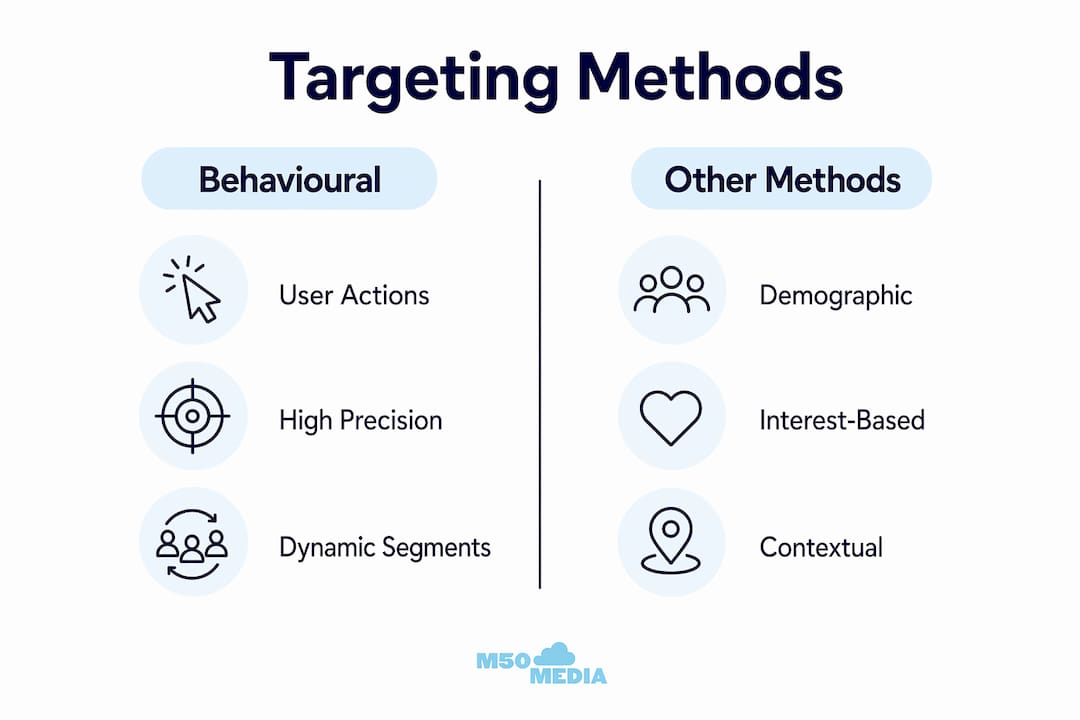
The core advantage of behavioural targeting is precision. Behavioural targeting outperforms contextual targeting on ROI when the underlying data is well managed. That qualifier matters. Poor data management erases the advantage entirely.
The benefits that matter most to marketers and business owners:
Higher conversion rates. Ads reach people who have already shown intent, not just people who might be interested someday.
Better ad spend efficiency. You stop paying to reach people who have zero interest in what you sell.
Continuity across sessions. Behavioural targeting creates what amounts to one-to-one conversations at scale, following a user’s interest across multiple visits and platforms.
Improved customer experience. Relevant ads feel helpful rather than intrusive. That distinction builds brand trust over time.
Contextual targeting still has a role, especially as third-party cookies disappear. The strongest campaigns blend both methods, using behavioural signals where available and contextual signals as a fallback.
What behavioural targeting strategies actually work in 2026?
The most effective behavioural targeting strategies in 2026 centre on first-party data. Third-party cookies are declining fast due to privacy regulations like GDPR and changes from browsers like Safari and Chrome. Marketers who built their entire targeting stack on third-party data are scrambling. Those who invested in first-party data collection are not.
Here are the segments and strategies worth prioritising right now:
High-intent product viewers. Users who viewed a product page multiple times within a short window signal strong purchase intent. Build a dedicated segment for them and serve retargeting ads with urgency or social proof.
Recent search behaviour. Someone who searched “best running shoes for flat feet” three times this week is not casually browsing. Capture that search behaviour through your site’s internal search data and act on it.
Cart abandoners. This segment is old but still wildly effective. A person who added something to their cart and left is one well-timed ad away from converting.
Lapsed customers. CRM data reveals customers who purchased six or more months ago but have not returned. Behavioural re-engagement campaigns for this group consistently outperform cold prospecting.
Cross-channel behaviour. Combine email open data, website visits, and social engagement into a single behavioural profile. Platforms like HubSpot and Salesforce make this kind of multi-channel data integration achievable even for smaller businesses.
Continuous feedback loops feeding engagement data back into your targeting system are critical. Segments go stale. A person who was actively shopping for a laptop three weeks ago has likely already bought one. Without feedback loops, you keep serving them laptop ads long after the moment has passed. That is annoying for the customer and wasteful for your budget.
Blending behavioural data with contextual signals is the winning approach right now. Combining first-party behavioural data with contextual targeting avoids privacy pitfalls while keeping ad relevance high. Think of it as wearing both a belt and suspenders. You are not taking chances.
Pro Tip: Run a quarterly audit of your behavioural segments. Remove stale criteria, update time windows, and check whether your highest-spend segments are still converting. Segments that made sense six months ago may be burning budget today.
What challenges and ethical concerns come with behavioural targeting?
Behavioural targeting is powerful, but it comes with real risks that marketers cannot afford to ignore.
Privacy regulations. GDPR in Europe, PIPEDA in Canada, and CCPA in California all restrict how you collect and use behavioural data. Non-compliance carries serious financial penalties.
Third-party cookie decline. The infrastructure that powered behavioural targeting for two decades is being dismantled. Blending behavioural and contextual data is now a necessity, not a nice-to-have.
Stale data risk. Behavioural data has a shelf life. Acting on outdated signals produces irrelevant ads that frustrate customers instead of converting them.
Creepiness factor. Ads that feel too personalised can backfire. If a customer feels surveilled rather than served, you lose their trust. That is hard to earn back.
Ethical behavioural targeting means collecting only what you need, being transparent about how you use it, and giving customers genuine control over their data preferences.
Ethical marketing practices are not just a legal requirement. They are a competitive advantage. Brands that handle data responsibly build the kind of customer loyalty that no ad budget can buy. Transparency in your data practices, clear opt-out options, and honest communication about personalisation all contribute to a healthier long-term relationship with your audience.
Key takeaways
Behavioural targeting delivers better marketing results than demographic methods because it acts on what people do, not assumptions about who they are.
Point | Details |
Definition is action-based | Behavioural targeting uses browsing, purchase, and search history to serve relevant ads. |
Speed is the mechanism | The full data-to-ad process completes in under 100 milliseconds, requiring clean, structured data. |
First-party data wins in 2026 | As third-party cookies decline, CRM and on-site data become your most valuable targeting assets. |
Feedback loops prevent waste | Refreshing segments regularly stops stale data from burning your ad budget on irrelevant audiences. |
Ethics build long-term loyalty | Transparent data practices and genuine opt-out options protect brand trust alongside campaign performance. |
Karl’s take on getting behavioural targeting right
Here is the uncomfortable truth I have seen play out with clients more times than I can count. Marketers get excited about behavioural targeting, set up their segments in week one, and then never touch them again. Six months later they wonder why their retargeting campaigns feel like shouting into a void.
Behavioural targeting is not a “set it and forget it” system. It is a living thing. The moment you stop feeding it fresh data and pruning dead segments, it starts working against you. I have seen businesses spend thousands of dollars retargeting people who bought their product weeks ago, simply because nobody updated the exclusion lists.
My honest recommendation is this: start with your first-party data before you touch anything else. Your website analytics, your CRM, your email engagement data. That is your gold. Third-party data is increasingly unreliable and increasingly regulated. Build your targeting foundation on data you own and control.
The other thing I push hard on is contextual pairing. Behavioural data tells you what someone did. Contextual data tells you what they are doing right now. Combining both gives you a much sharper picture of intent. A person who researched running shoes last week and is currently reading a marathon training article? That is about as close to a sure thing as digital marketing gets.
Test your segments. Refresh them. Kill the ones that are not working. Behavioural targeting rewards the marketers who stay curious and keep iterating. If you want to go deeper on micro-targeting techniques that complement this approach, that is a natural next step.
— Karl
Ready to put behavioural targeting to work for your business?
Understanding behavioural targeting is one thing. Actually building a data-driven marketing system that converts is another challenge entirely.

At M50media, Karl works directly with business owners and marketers to build targeting strategies grounded in real data, not guesswork. Whether you are starting from scratch or trying to fix a campaign that has gone sideways, the digital coaching programme covers everything from first-party data setup to segment strategy and ad creative. If you want a faster entry point, book a free Marketing SOS call and get a clear-eyed look at where your targeting stands today. No fluff, just practical direction from someone who has been in the trenches of digital marketing for years.
FAQ
What is behavioural targeting in simple terms?
Behavioural targeting is the practice of using a person’s online actions, like pages visited and products searched, to show them ads that match their demonstrated interests rather than their demographic profile.
How does behavioural targeting work technically?
The system collects user behaviour data, sorts users into segments, and matches relevant ads during a real-time auction. The entire process from data collection to ad delivery completes in under 100 milliseconds.
What is the difference between behavioural and contextual targeting?
Behavioural targeting uses a person’s past actions to predict intent. Contextual targeting matches ads to the content of the page being viewed. The strongest campaigns blend both methods, especially as third-party tracking declines.
Is behavioural targeting legal in Canada?
Behavioural targeting is legal in Canada under PIPEDA, provided you collect data with informed consent, use it only for stated purposes, and offer users clear opt-out options. Non-compliance carries regulatory risk.
What data sources power behavioural targeting?
The primary sources are first-party data from your website, app, and CRM, along with search history and email engagement. Tools like Google Analytics, Meta Pixel, HubSpot, and Salesforce are commonly used to collect and activate this data.
Recommended
Comments