What is micro-targeting? A 2026 guide for marketers

TL;DR:
Micro-targeting uses detailed data to deliver personalized messages to small groups or individuals, making marketing highly precise. It relies on a three-stage process involving data collection, audience profiling, and tailored message delivery, primarily using first-party data in 2026 due to tighter privacy regulations. Successful implementation requires matching distinct creative content to well-defined segments, emphasizing ethical practices and ongoing optimization.
Micro-targeting is defined as the practice of using detailed online and first-party data to deliver personalised advertising messages to individuals or very small audience segments. Think of it as the opposite of a billboard on the highway. Instead of waving at everyone driving past, you’re slipping a handwritten note under the door of exactly the right person. Platforms like Meta and Google power most of this today, and the Cambridge Analytica scandal put the concept on the front page for everyone else. With privacy rules tightening across Europe, California, and Canada in 2026, understanding how this strategy works has never been more relevant for marketers and business owners.
What is micro-targeting and how does it work in digital marketing?
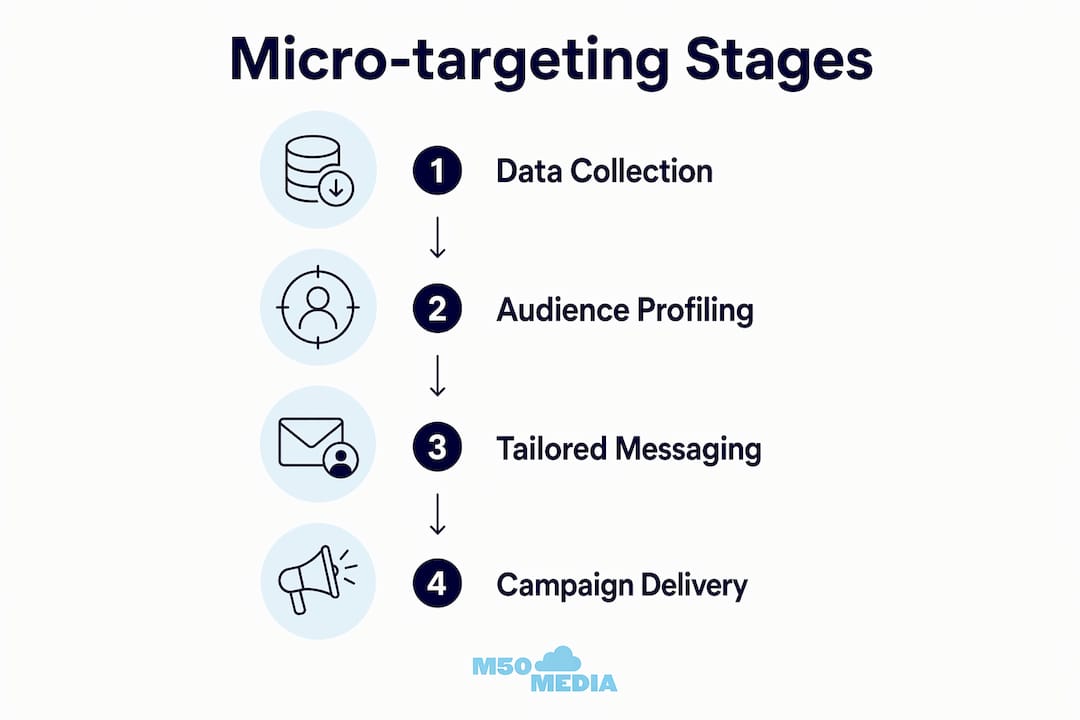
Micro-targeting is a three-stage process: collect data, build audience profiles, then deliver tailored messages. That’s the skeleton. The meat on those bones is where it gets interesting.

Stage one is data collection. You’re pulling from first-party sources like email lists, purchase history, and website behaviour, plus third-party data where regulations still allow it. Stage two is audience profiling, where you group people by shared traits. Stage three is message delivery, where each group sees creative content built specifically for them. Not a slight variation. A genuinely different message.
The data types used span four main categories. Here’s a quick breakdown:
Data type | What it includes | Example |
Demographic | Age, gender, income, education | Women aged 30-45 with household income over $80K |
Geographic | Country, city, postal code | Targeting by specific neighbourhoods in Toronto |
Behavioural | Past purchases, browsing history, app usage | Users who viewed a product page three times |
Psychographic | Lifestyle, values, interests, personality | Outdoor enthusiasts who prioritise sustainability |
Each data type adds a layer of precision. Combining all four is where micro-targeting separates itself from basic segmentation. A 35-year-old in Vancouver who bought hiking boots last month and follows environmental accounts is a very different prospect than a 35-year-old in Calgary who bought the same boots as a gift.
One practical nuance worth knowing: micro-targeting targets clusters rather than isolated individuals in most real-world campaigns. You need enough people in a segment for the algorithm to optimise bids and delivery. True one-to-one targeting sounds great in theory but falls apart statistically at scale.
Pro Tip: Build your audience segments in Meta Ads Manager or Google Ads using layered conditions. Start broad, then add behavioural and psychographic filters one at a time. Watch your reach number. When it drops below a few thousand, you’ve likely gone too granular for the algorithm to work efficiently.
Micro-targeting vs traditional marketing: what are the differences?
Traditional broad targeting is like casting a fishing net across the whole lake. You catch a lot of fish, but most of them aren’t what you wanted. Micro-targeting is more like fly fishing. Slower, more deliberate, and you usually get exactly what you came for.
Micromarketing, a related concept from HubSpot’s marketing framework, targets very small groups or individuals and offers higher ROI and better quality leads. The tradeoff is effort. Micro-targeting sits within this family but leans heavily on data-driven automation to make that effort manageable at scale.
Here’s how the approaches compare side by side:
Approach | Granularity | Data reliance | Cost per impression | ROI potential |
Mass marketing | Very broad | Low | Low | Low |
Niche marketing | Moderate | Moderate | Moderate | Moderate |
Micromarketing | High | High | Higher | High |
Micro-targeting | Very high | Very high | Higher | Very high |
The benefits of micro-targeting over traditional methods are real, but they come with conditions. You need quality data, distinct creative for each segment, and a platform capable of delivering at that level of precision. Without those three things, you’re paying micromarketing prices for mass-marketing results.
A few honest pros and cons to keep in mind:
Higher engagement rates because messages match individual context and intent
Better conversion rates when segmentation logic aligns with actual customer behaviour
More efficient ad spend because you’re not paying to reach people who will never buy
Requires significantly more creative production (one ad for everyone becomes ten ads for ten segments)
Data quality problems compound quickly at high granularity
Regulatory exposure increases when you’re working with sensitive behavioural signals
What are the benefits and challenges of micro-targeting in 2026?
The benefits are straightforward. Personalised messages outperform generic ones. When someone sees an ad that feels like it was written for them specifically, engagement goes up. So does the likelihood they’ll click, convert, and come back. For digital marketing ROI, that precision matters enormously, especially when budgets are tight.
The challenges in 2026 are more complicated than they were five years ago. Privacy constraints from GDPR in Europe, CCPA in California, and Apple’s App Tracking Transparency framework have dramatically reduced access to third-party data. The result is that effective micro-targeting now depends almost entirely on first-party data: your email lists, your CRM records, your website analytics, and direct customer interactions.
The ethical dimension is the one most marketers underestimate. Warning users that they are being micro-targeted has little effect on how persuasive those ads are. That finding matters. It means transparency disclosures, while legally necessary, don’t actually reduce the influence of targeted ads on behaviour. That puts the ethical responsibility squarely on the marketer, not the platform or the disclaimer.
Here’s a practical checklist for staying on the right side of both regulations and your audience:
Collect only the data you actually need for your campaign objectives
Make your data collection practices visible and easy to understand in plain language
Give users a genuine opt-out that works
Avoid targeting based on sensitive categories like health conditions, religion, or financial distress
Review your campaigns against GDPR and CASL requirements before launch
Pro Tip: Your first-party data is your most valuable asset in 2026. Invest in building it intentionally. An email list built on consent and genuine value exchange will outperform any third-party audience you can rent from a data broker.
How to implement effective micro-targeting strategies
Knowing what micro-targeting is and actually running a campaign that works are two very different things. Most teams stumble at the same spot: they narrow the audience beautifully, then serve everyone in that audience the exact same generic creative. That’s like buying a custom suit and then wearing it with flip-flops. The effort is wasted.
Effective micro-targeting requires building what’s called an audience-creative matrix. That means pairing each audience segment with a distinct message designed specifically for their context, intent, and stage in the buying journey. Here’s how to build one:
Define your segments using layered data. Start with demographics, then add behavioural signals like past purchases or page visits, then layer in psychographic traits where available. Each segment should be meaningfully different from the others, not just slightly older or slightly further north.
Map a specific message to each segment. Ask yourself: what does this person care about right now? What problem are they trying to solve? What objection do they have? Write the ad for that person, not for your average customer.
Set delivery rules on your platform. In Meta Ads Manager or Google Ads, use custom audiences, lookalike audiences built from your best customers, and exclusion lists to make sure each segment sees only its matched creative.
Track the right metrics per segment. Click-through rate tells you if the message resonated. Conversion rate tells you if the offer matched intent. Cost per acquisition tells you if the precision is paying off financially. Look at these numbers by segment, not just overall.
Iterate based on what the data shows. If one segment converts at three times the rate of another, find out why. Is it the message? The offer? The timing? Then apply that learning across your other segments.
Personalised strategies consistently outperform generic ones in e-commerce and service-based businesses alike. The mechanics are the same whether you’re selling software subscriptions or handmade candles. Segment, match, deliver, measure, repeat.
One pitfall to avoid: don’t let your segments get so small that the platform can’t optimise. Micro-segments need statistical stability to allow bid adjustments and delivery optimisation to function properly. If your audience is under a few thousand people, consider whether you’re targeting or just guessing.
Key takeaways
Micro-targeting works when precise audience segmentation is paired with distinct creative messaging and first-party data, making it the most precise and ethically demanding approach in digital marketing today.
Point | Details |
Core definition | Micro-targeting uses detailed data to deliver personalised messages to individuals or small groups. |
Three-stage process | Data collection, audience profiling, and tailored message delivery are the three operational stages. |
First-party data is critical | Privacy laws in 2026 have made consented first-party data the foundation of any compliant campaign. |
Creative must match the segment | Reusing generic creative across segments cancels out the precision of your audience work. |
Ethics are your responsibility | Transparency disclosures don’t reduce ad persuasiveness, so ethical data use falls on the marketer. |
Karl’s take on micro-targeting in 2026
Here’s something I’ve noticed working with business owners on their digital marketing: most people treat micro-targeting as a technology problem. They think if they just find the right platform setting or the right data source, the results will follow automatically. That’s not how it works.
The real challenge is creative. I’ve seen campaigns with beautifully segmented audiences completely underperform because the ad copy was written for nobody in particular. Generic headline, stock photo, vague call to action. The algorithm delivered it to exactly the right people, and those people ignored it completely. Precision targeting with lazy creative is just an expensive way to be ignored.
The other thing I’d push back on is the idea that micro-targeting is only for big brands with massive data sets. Your email list, your past customers, your website visitors: that’s first-party data, and it’s genuinely powerful. A local business with 2,000 engaged email subscribers and a clear understanding of what those people care about can run micro-targeted campaigns that outperform a national brand spending ten times more on third-party audiences.
The ethical piece matters too, and not just for compliance reasons. Customers notice when they feel surveilled rather than served. The line between “this ad is weirdly relevant” and “this ad is creepy” is thinner than most marketers admit. Staying on the right side of that line is good ethics and good business.
— Karl
Ready to put micro-targeting to work for your business?
Understanding the theory is one thing. Building campaigns that actually convert is another. At M50media, Karl works directly with business owners and marketing professionals to turn strategy into results. Whether you’re starting from scratch with your first-party data or trying to fix a campaign that isn’t performing, the M50media coaching programme gives you a clear plan built around your specific business.

Not sure where to start? Book a free Marketing SOS call with Karl and walk away with a concrete next step for your micro-targeting strategy. No fluff, no generic advice. Just a focused conversation about what’s actually going to move the needle for you. Check out everything M50media offers at m50media.com.
FAQ
What is the micro-targeting definition in simple terms?
Micro-targeting is the use of detailed data to deliver personalised advertising messages to individuals or very small groups. It relies on demographic, behavioural, geographic, and psychographic data to match the right message to the right person at the right time.
How does micro-targeting differ from regular audience targeting?
Regular targeting groups large audiences by broad traits like age or location. Micro-targeting layers multiple data types to create very narrow segments, often down to clusters sharing specific behavioural patterns, resulting in far more personalised and relevant messaging.
What data do you need for micro-targeting strategies?
The most effective micro-targeting in 2026 relies on first-party data such as email lists, purchase history, and website behaviour. Third-party data access has been significantly reduced by GDPR, CCPA, and Apple’s App Tracking Transparency framework.
Is micro-targeting ethical?
Micro-targeting raises real ethical concerns around privacy and manipulation. Research shows that warning users about targeting does not reduce the persuasive effect of ads, which means the ethical responsibility rests with the marketer to use data responsibly and transparently.
What platforms are used for micro-targeting campaigns?
Meta Ads Manager and Google Ads are the primary platforms for micro-targeting. Both allow layered audience conditions using custom audiences, lookalike audiences, and targeted ad delivery rules that match segments to specific creative content.
Recommended
Comments