Brand equity for small business growth in 2026

TL;DR:
Strong brand equity creates loyalty, allows premium pricing, and reduces customer acquisition costs.
Building brand equity involves consistent messaging, quality, customer experience, and social proof.
Digital metrics like search share, sentiment, and NPS help track brand strength for small businesses.
You don’t need a Super Bowl ad budget or a celebrity endorsement to have a brand people genuinely love. A strong brand name alone can drive measurable growth even before customers try a single product, which is honestly a little wild when you think about it. Most entrepreneurs assume brand equity is a big-brand luxury, like a corner office or a kombucha bar in the break room. It’s not. Brand awareness strongly shapes customer acquisition at every business size, and this guide will show you how to use it to your advantage.
Table of Contents
Key Takeaways
Point | Details |
Brand equity defined | Brand equity means the value your brand adds through recognition, quality, and customer trust. |
Drives business growth | Stronger brand equity leads to higher sales, loyalty, and pricing advantages for small businesses. |
Measurement matters | Using modern digital metrics helps you monitor your brand equity and improve over time. |
Strategic focus | Targeting consistency, authenticity, and customer experience builds real brand equity. |
Defining brand equity: more than a logo
Let’s clear something up right away. Brand equity is not your logo. It’s not your colour palette or your clever tagline (although those things do play a role). Brand equity is the extra value your brand name adds to a product or service beyond what it physically does. Think of it this way: two cups of coffee, same beans, same roast. One is handed to you in a plain white cup, and one arrives in a cup with a logo you recognise and trust. You’d probably pay more for the second one. That’s brand equity at work.
So what’s actually inside this concept? Here are the four core components:
Brand awareness: Do people know you exist? Can they recall your name when they need what you offer?
Perceived quality: Do customers assume your product is good, even before they’ve tried it?
Brand associations: What feelings, images, or ideas pop into people’s heads when they hear your name?
Brand loyalty: Are customers coming back, or are you constantly starting from scratch?
Here’s the thing a lot of small business owners get wrong:
Brand equity is not something you achieve once and bank forever. It’s built through repeated, consistent experiences that confirm what you say you are.
The visual identity is just the front door. The real equity lives in the mind of your customer. And here’s why that matters practically: strong brand equity lets you charge more, lose fewer customers to competitors, and win referrals you didn’t even ask for. Brand awareness strongly shapes customer acquisition, which means the more people recognise and respect your name, the lower your cost to bring in new business. If you want to dig deeper into how branding connects to loyalty, this look at branding and small business loyalty is a great next read.
How brand equity drives results for small businesses
Okay, so you know what brand equity is. But you’re a small business owner, not a marketing professor, so let’s talk about what it actually does for you on a Tuesday morning when you’re trying to grow.
Brand equity translates into three very tangible wins: higher sales conversions, the ability to charge premium pricing, and stronger repeat business. In fact, CBBE components positively relate to market share, particularly for consumer goods brands in developed markets. That’s not just academic fluff; it means the investment you put into your brand reputation pays back in real revenue.

To make it even clearer, here’s a comparison between two hypothetical local bakeries:
Factor | Bakery A (low equity) | Bakery B (high equity) |
Pricing power | Competes on lowest price | Commands a premium |
Customer loyalty | Low repeat visits | High repeat and referral |
New customer cost | High (constant ads) | Lower (word of mouth) |
Crisis resilience | One bad review hurts badly | Community defends them |
Now, how does equity actually shape the journey a customer takes? Here’s a simple breakdown:
Discovery: A customer hears your name. Strong brand awareness means they’re already curious, not suspicious.
Consideration: Perceived quality tips the scale in your favour when they’re comparing options.
Purchase: Positive associations push them over the line, even at a higher price point.
Repeat purchase: Brand loyalty means they come back without you having to beg.
Pro Tip: Don’t try to build all four equity components at once when you’re just starting out. Focus on awareness first, then perceived quality. You can explore effective marketing strategies to find the right sequence for your stage of growth. Once awareness is solid, lean into the online marketing advantages that let you build quality signals quickly and affordably.
Key factors shaping your brand equity
Now that you can see the payoff, let’s talk about what actually moves the needle. Brand equity doesn’t just appear because you want it to (if only!). It’s built or broken by very specific, controllable actions.
Here are the biggest positive drivers:
Consistent messaging: Saying the same thing, in the same tone, across every channel. Customers trust what feels predictable.
Customer experience: Every touchpoint, from your emails to your packaging, either confirms or contradicts your brand promise.
Social proof: Reviews, testimonials, and word of mouth act as third-party endorsements of your perceived quality.
Product quality: Obvious, but worth saying. Promises without delivery erode equity fast.
And here’s what quietly tears it down:
Positive influence | Negative influence |
Consistent brand voice | Changing your positioning every few months |
Premium or mid-market channel choices | Selling through hard discounters |
Authentic storytelling | Generic, forgettable messaging |
Responsive customer service | Ignoring complaints publicly |
That second row in the table is worth a pause. Selling through hard discounters can actively damage brand equity by locking your name into low-price associations in the minds of shoppers. It feels like a growth move in the short term, but it can quietly undermine the very premium perception you’re trying to build.
Your brand is what people say about you when you’re not in the room. Every customer touchpoint is a vote for or against the version of you they’ll describe.
Pro Tip: You don’t need to overhaul your entire operation to improve equity. Start with your most frequent customer touchpoint. Refine the language, the visual consistency, or the follow-up process there first. Small tweaks at high-frequency moments add up fast. Check out these brand content ideas and a solid guide to build your brand online for inspiration.
Measuring brand equity in the digital age
Here’s a question that trips up a lot of entrepreneurs: how do you actually know if your brand equity is growing? Old-school methods like brand recall surveys and focus groups were fine for big brands with big budgets. But for you? We need something faster and cheaper.
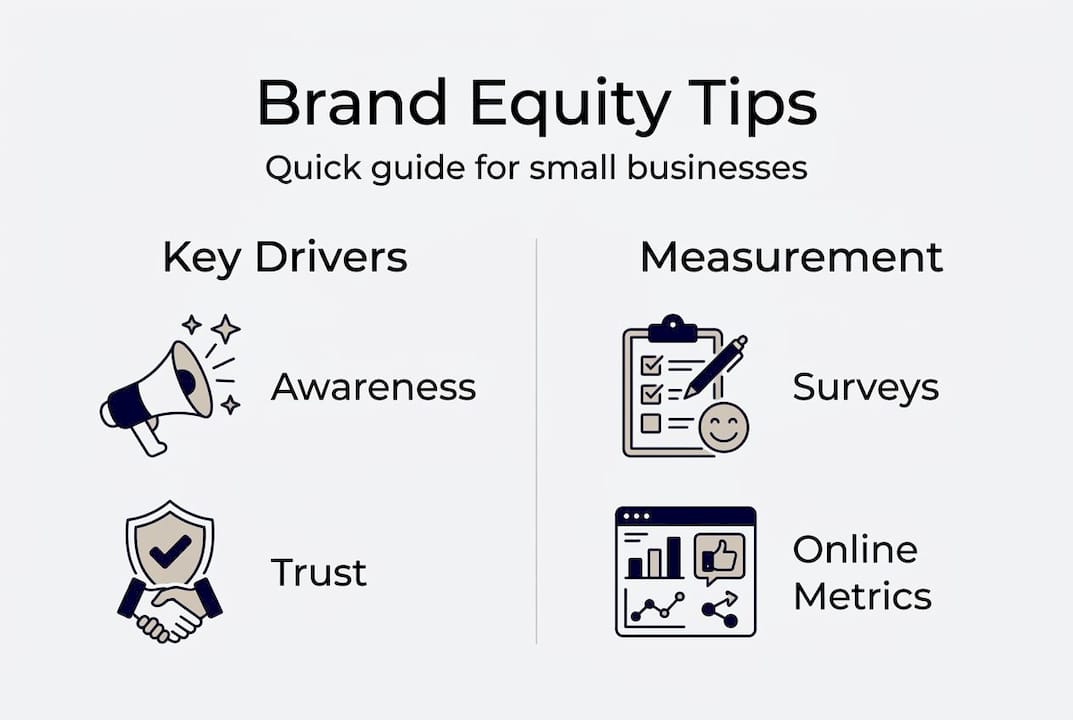
Traditional metrics alone are no longer enough. Traditional metrics are insufficient in the digital era; modern brand equity measurement needs to incorporate share of search, digital awareness signals, and online sentiment. That’s a fancy way of saying: are more people searching for your name, talking about you, and saying good things?
Here are the digital-first metrics worth tracking:
Share of search: How often does your brand name appear in search results compared to competitors? Use Google Search Console or a simple Google Trends comparison.
Online sentiment: What’s the emotional tone of reviews, comments, and mentions? Tools like Google Alerts are free and surprisingly useful.
Social mentions: Are people tagging you, talking about you, or sharing your content without being asked?
Net Promoter Score (NPS): Ask customers one question: how likely are you to recommend us? Track this over time.
Repeat purchase rate: Customers who come back are voting for your brand equity with their wallets.
Pro Tip: Entrepreneurs should leverage personalisation and niche appeal rather than mimicking big brand measurement systems. A simple monthly survey to your best customers combined with repeat purchase tracking tells you more than an expensive brand study ever would. You can also measure your digital marketing ROI alongside equity signals for a fuller picture, and if you’re new to the space, the digital branding guide for 2026 is a great starting point.
What most small businesses miss about brand equity
Here’s the perspective that most marketing content glosses over: the biggest mistake small business owners make isn’t ignoring brand equity. It’s assuming they have to build it the same way large corporations do.
The conventional wisdom says brand equity is a game for players with massive ad spends and agencies on retainer. But that thinking is, frankly, outdated and a little discouraging. Small businesses can build fierce, loyal brand equity in niche markets faster than any large brand can pivot. Why? Because you can actually show up. You can respond to a comment in real time. You can remember a regular customer’s name. You can be the business that people feel personally connected to, and that kind of connection is genuinely hard to buy at scale.
Where small businesses really go wrong is when they try to copy big-brand playbooks. Broad messaging, generic positioning, and impersonal campaigns are the enemies of small business brand equity. Distinctiveness wins over size every single time.
The best equity builder available to you right now is consistency and presence. Track what makes your business memorable, lean into it shamelessly, and protect it. A deeper look at brand loyalty perspective can help you figure out where your unique edge already lives.
Strengthen your brand with expert guidance
Building brand equity sounds like a big project, and honestly, it is. But it’s also one of the most rewarding investments you’ll make in your business because the returns compound over time. The stronger your brand becomes, the less you spend on acquisition and the more your customers do your marketing for you. Pretty sweet deal, right?

If you’re ready to stop guessing and start building a brand strategy that actually fits your business size and goals, Karl Lundgren and the M50 Media team are here for it. Whether you want a quick direction check through a free marketing SOS call, deeper support through coaching services, or just want to explore the full library of marketing resources for small business, there’s a path forward for wherever you’re starting from.
Frequently asked questions
What exactly is brand equity in simple terms?
Brand equity is the added value your business name brings to your products or services, essentially the trust and preference customers feel toward your brand over a nameless alternative.
How can small businesses increase their brand equity?
Focusing on consistent messaging, delivering great customer experiences, and building genuine social proof are the core drivers of equity growth for businesses at any size.
Can brand equity be measured digitally now?
Absolutely. Digital metrics like share of search, sentiment analysis, and NPS surveys are practical and affordable ways to track brand equity without needing a big research budget.
Does discounting always hurt brand equity?
Not always, but frequent discounting or selling through hard discounters can anchor your brand to low-price perceptions, so keep your core value story clear and consistent if you do run promotions.
Recommended
Comments