Build a winning entrepreneur marketing plan in 5 steps

TL;DR:
Clear mission, value proposition, and buyer personas are essential for effective marketing.
Use 90-day plans with weekly reviews to stay agile and responsive.
Track KPIs and utilize AI tools to measure and optimize marketing efforts.
So you’ve got a brilliant business idea, a half-finished Instagram profile, and approximately 47 browser tabs open about “how to market your business.” Sound familiar? 😅 Marketing planning can feel like trying to assemble IKEA furniture without the instructions — lots of pieces, no clear order, and you’re not entirely sure what you’re building. The good news? There’s a structured, step-by-step framework that cuts through the noise and gives your digital marketing direction, purpose, and results. This article walks you through every stage, from nailing your business identity to measuring what’s actually working. Let’s sort this out.
Table of Contents
Key Takeaways
Point | Details |
Build on your mission | A clear mission and value proposition lay the groundwork for all marketing decisions. |
Focus on actionable goals | Quarterly objectives and weekly reviews speed up progress and digital adaptability. |
Use the right channels | Select platforms and messaging that align with your ideal customer’s journey. |
Measure and refine | Track your KPIs and iterate quickly for constant improvement and growth. |
Seek expert support | Professional coaching and guidance boost the impact and efficiency of your plan. |
Clarify business mission, value proposition and customer profile
Before you post a single reel or send one email campaign, you need to know who you are, what you offer, and who you’re talking to. Sounds obvious, right? Yet so many entrepreneurs skip this step and end up marketing to everyone, which is basically marketing to no one.
Your mission statement is your north star. It tells your audience (and frankly, yourself) why your business exists beyond making money. Your value proposition is the punchy answer to “why should I choose you over everyone else?” Get these two things crystal clear and every marketing decision becomes a whole lot easier.
Next up: buyer personas. These are semi-fictional profiles of your ideal customers, built from real data and educated guesses. The core mechanics of a solid marketing plan include defining buyer personas and mapping the customer journey as foundational steps before anything else. A persona isn’t just “women aged 25-40.” It’s Sarah, 34, runs a small bakery, scrolls Instagram at 9pm, and Googles “how to get more catering clients” at least twice a week.
Here’s a quick look at what a buyer persona table might include:
Attribute | Details to capture |
Demographics | Age, location, income, job title |
Goals | What they want to achieve |
Pain points | What keeps them up at night |
Digital touchpoints | Instagram, Google, email, LinkedIn |
Buying triggers | What prompts them to take action |
Once you have your personas, map out their customer journey. Where do they first discover you? What convinces them to buy? What makes them come back? This journey mapping feeds directly into your content marketing strategy and ensures you’re creating the right content at the right stage.
Key things to nail in this phase:
Write a one-sentence mission statement that feels human, not corporate
Draft your value proposition using the format: “We help [who] achieve [what] by [how]”
Build at least two buyer personas using real customer interviews or social analytics
Identify three to five digital touchpoints where your ideal customer hangs out
Pro Tip: Don’t just guess at your personas. Spend 20 minutes scrolling through the comments on your competitors’ social posts. Real customers tell you exactly what they want and what frustrates them. Gold mine.
Conduct SWOT analysis and set marketing objectives
Okay, you know who you are and who you’re serving. Now it’s time to get brutally honest about where you stand. Enter the SWOT analysis: Strengths, Weaknesses, Opportunities, and Threats. It sounds like a corporate buzzword bingo card, but done right, it’s genuinely one of the most useful exercises you’ll do.

For digital marketing specifically, your strengths might include an engaged email list or strong SEO rankings. Weaknesses could be a slow website or inconsistent posting schedule. Opportunities might be an underserved niche on YouTube. Threats? Maybe a well-funded competitor just entered your space. Be real with yourself here.
Once your SWOT is done, use it to set SMART objectives. SMART stands for Specific, Measurable, Achievable, Relevant, and Time-bound. “Get more followers” is not a SMART goal. “Grow Instagram followers by 20% in 90 days through weekly Reels” absolutely is. The SBA’s business planning framework recommends setting KPIs like lead rate, click-through rate (CTR), and return on investment (ROI) as part of every marketing plan.
Here’s how annual versus quarterly planning stacks up for small businesses:
Planning type | Pros | Cons |
Annual plan | Big picture vision, consistent direction | Slow to adapt, often outdated by Q2 |
Quarterly (90-day) plan | Agile, measurable, easier to adjust | Requires more frequent review sessions |
For most entrepreneurs, quarterly wins every time. Markets shift fast, algorithms change overnight, and your customers’ needs evolve. A marketing checklist can help you stay on track between planning cycles without losing momentum.
Steps to set your marketing objectives:
Review your SWOT and identify your top two or three priorities
Write one SMART goal per priority
Assign a KPI to each goal (CTR, leads generated, conversion rate)
Set a 90-day timeline with monthly check-in milestones
Document everything in a shared doc so your whole team (even if that’s just you) can track progress
“Prioritise 90-day actionable plans with weekly reviews over annual planning. Use templates to get started quickly and build the habit of consistent measurement.” This principle from the SBA is one of the online marketing advantages that separates growing businesses from stagnant ones.
Look at content marketing examples from businesses in your niche to see how others translate SWOT insights into real campaigns.
Choose your marketing mix and build your content calendar
With your objectives locked in, it’s time to choose your weapons. (Marketing weapons. Not actual weapons. Just to be clear. 😄)
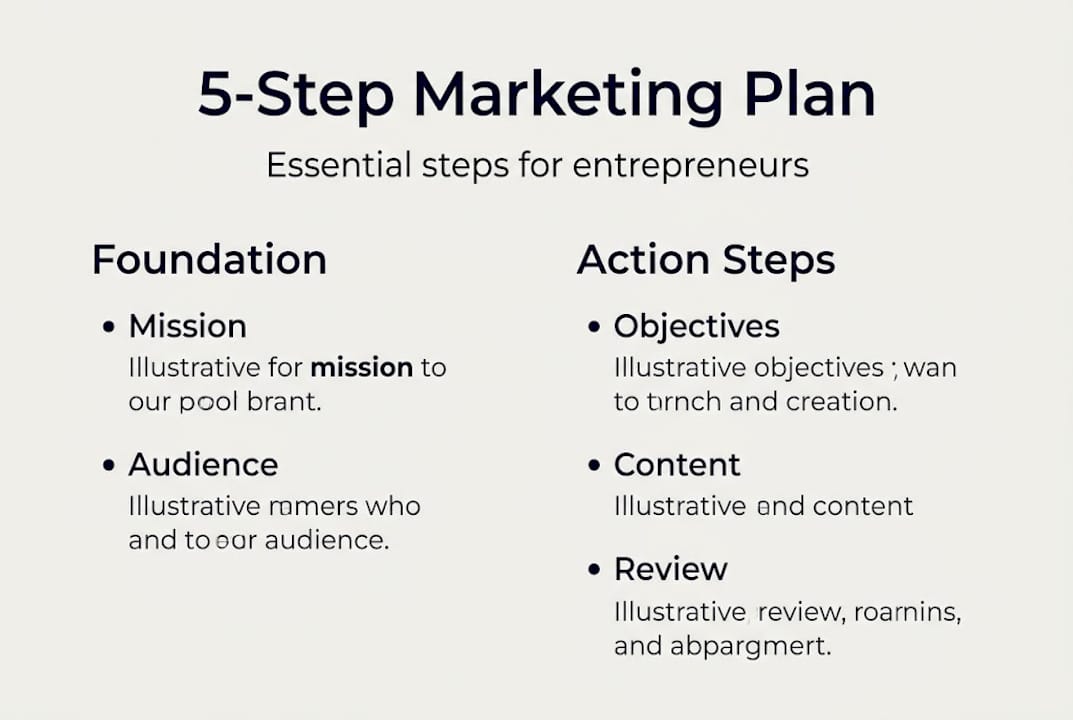
The 5 Ps of marketing — Product, Price, Place, Promotion, and People — give you a framework to think through every angle of your marketing mix. For digital entrepreneurs, “Place” means your online channels, and “Promotion” means how you communicate your value across those channels. The SBA’s planning guide confirms that deciding your marketing mix is a core mechanic of any effective entrepreneur marketing plan.
Best channels for small businesses in 2026:
Social media (Instagram, TikTok, LinkedIn depending on your audience)
Email marketing (still the highest ROI channel, full stop)
SEO and blogging (long-term traffic that compounds over time)
Paid ads (Google Ads or Meta Ads for faster results when budget allows)
Partnerships and collaborations (often underrated and wildly effective)
Once you’ve chosen your channels, build a content calendar. A solid content planning guide will save you from the “what do I post today” panic that hits every entrepreneur at 7am on a Tuesday.
Steps to build your 90-day content calendar:
List your SMART goals and identify which content types support each one
Choose your posting frequency per channel (realistic, not aspirational)
Brainstorm content themes for each month aligned to your customer journey
Map specific content pieces to specific dates in a spreadsheet or tool like Notion or Trello
Build in a weekly review slot to assess what’s working and adjust
Using content marketing tips from proven frameworks helps you create content that actually converts, not just content that fills space. And if you need inspiration for social, check out creative social media ideas that work specifically for small businesses.
Pro Tip: AI tools like ChatGPT or Jasper can help you brainstorm content ideas and draft copy in minutes. But always run your ideas through the filter of real customer feedback. AI is fast; your customers are right. Combine both and you’re unstoppable.
Also worth noting: businesses that commit to consistent content creation see content marketing drives more leads compared to those that post sporadically. Consistency is the secret ingredient nobody talks about enough.
Budget, measure and refine your plan for growth
Here’s where things get real. You can have the most beautiful marketing plan in the world, but if you’re not tracking results and managing your budget, you’re flying blind. And flying blind is only fun in action movies.
Start with two numbers every entrepreneur needs to know: Customer Acquisition Cost (CAC) and Lifetime Value (LTV). CAC is how much you spend to acquire one new customer. LTV is how much revenue that customer generates over their entire relationship with you. If your LTV is higher than your CAC, you have a healthy, scalable business. If it’s not, you have a problem worth fixing immediately.
The SBA’s business planning framework includes budgeting with CAC and LTV forecasts as essential components of any entrepreneur marketing plan. These aren’t just fancy metrics for big corporations. They’re survival tools for small businesses.
Key performance indicators to track in your digital marketing plan:
Lead rate (how many visitors become leads)
Click-through rate (CTR) on emails and ads
Conversion rate (how many leads become customers)
Cost per lead (total spend divided by leads generated)
Return on ad spend (ROAS) for paid campaigns
Organic traffic growth month over month
A good digital marketing plan guide will help you set benchmarks for each of these metrics based on your industry. Don’t compare your CTR to a Fortune 500 company. Compare it to your own last month.
Review weekly. Test monthly. Adjust quarterly. That’s the rhythm. Use marketing tools for growth like Google Analytics, Mailchimp, or HubSpot to make measurement less painful and more automatic.
Stat callout: Businesses that consistently track and optimise their marketing KPIs see measurably better ROI within the first 90 days compared to those who set and forget their plans. The data doesn’t lie.
Why quick, iterative planning beats annual marketing strategies
Here’s a hot take: that 40-page annual marketing plan you spent three weeks building? It was probably outdated by the time you finished it. 😬
The digital landscape moves fast. Algorithm changes, new platforms, shifting customer behaviour, economic surprises — annual plans simply can’t account for all of it. The SBA recommends prioritising 90-day plans with weekly reviews over rigid annual strategies, and honestly, this is one of the best pieces of advice any small business owner can follow.
Think of your digital marketing plan less like a novel and more like a TV series. Each 90-day cycle is a season. You keep the overarching story, but you adapt the plot based on what your audience responds to.
AI tools can dramatically speed up your planning process, from generating content ideas to analysing campaign data. But the real magic happens when you combine AI efficiency with genuine customer insight. Talk to your customers. Read their reviews. Show up in their communities. No algorithm can replicate that.
Pro Tip: Block 30 minutes every Monday morning for a marketing review. Check your KPIs, note what worked last week, and adjust your plan for the week ahead. Make it non-negotiable, like your morning coffee. ☕
Elevate your marketing plan with expert coaching
You’ve got the framework. Now imagine having an expert in your corner to help you execute it. 🙌

At M50 Media, Karl Lundgren’s business coaching programmes are built specifically for entrepreneurs who want to turn marketing plans into measurable, real-world results. Whether you need ongoing strategy support or just a focused session to get unstuck, the digital coaching options are designed to meet you where you are. Not sure where to start? Book a free Marketing SOS Call and get personalised guidance in under an hour. Your next 90-day plan could be your best one yet.
Frequently asked questions
What is the first step in developing a marketing plan for entrepreneurs?
Start by clarifying your mission, value proposition, and ideal customer profile. The foundation of every plan is knowing who you serve and why they should choose you.
How often should an entrepreneur update their marketing plan?
Skip the annual update and use 90-day cycles with weekly reviews instead. This keeps your strategy agile and responsive to real market changes.
Which tools help measure marketing effectiveness?
Track KPIs like lead rate, CTR, CAC, and LTV using tools like Google Analytics or HubSpot. SMART objectives with KPIs and content calendars make measurement consistent and actionable.
How can AI assist with marketing planning?
AI speeds up content calendar creation, campaign tracking, and customer segmentation, but always ground AI outputs in customer data to ensure relevance and accuracy.
Recommended
Comments